Tesla Teams With Nvidia on Powercore for AI Data Centres
Tesla says it is working with Nvidia on 800V data-centre power, with Powercore linking AI computing, Megapack batteries and solar.


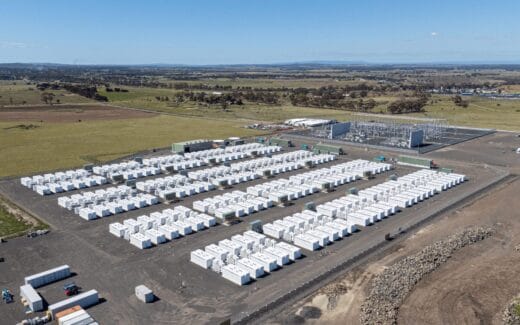
Tesla Megapack file image. Image: Tesla
Tesla says it is working with Nvidia on the engineering needed to power next-generation AI data centres at 800 volts DC, giving its newly unveiled Powercore a role beyond battery storage.
In a detailed announcement on November 17, the company outlined how the equipment could feed computing hardware directly from the medium-voltage grid. It expands on the initial Powercore reveal, which introduced a combined transformer, inverter and breaker due to begin operating in 2027.
Fewer steps between the grid and the chips
Today, Tesla explains, much data-centre equipment accepts 415 to 480 volts AC. Power passes through transformers and is converted again for computing, cooling and networking equipment.
Powercore is designed to take medium-voltage AC straight to 800 volts DC in one step. Tesla says cutting conversion losses would let operators run more GPUs using the same grid connection. Megapack batteries can connect directly to the DC system for backup power and to smooth changes in demand.
Tesla says it already has 10 GWh of Megapack storage operating at data centres. The Nvidia collaboration builds on Megapack’s qualification under the DSX Ready programme, where it was among the first battery energy-storage solutions.
A solar-powered data-centre pitch
The bigger idea is to supply the whole chain: solar generation, battery storage and the equipment connecting them to computing hardware.
Tesla estimates that, in many parts of the world, a 100 MW data centre could be effectively powered by 500 MW of solar and 1.7 GWh of batteries. That is the company’s proposed configuration, not a newly announced customer installation.
For solar projects, Powercore converts DC from the panels directly to medium-voltage AC. It supports existing 1,500-volt systems and emerging 2,000-volt designs. Tesla also reiterated its commitment to manufacture 100 GW of solar annually in the U.S., following work at its Texas solar factory site.
More detail on the hardware
The new specifications include 98.86% peak efficiency, an operating range from -40°C to 55°C and warranties of up to 25 years. Tesla says the modular components can be serviced without replacing an entire unit.
In battery-storage projects, Powercore replaces two conversion stages with one. Tesla says the previous architecture had twice the losses, meaning the change could deliver more usable energy from the same batteries.
The company’s announcement still puts the first U.S.-made units into operation in 2027. It does not name a launch customer or disclose a price.
Tesla news, every morning.
Software updates, deliveries, FSD rollouts. Five minutes. Free.