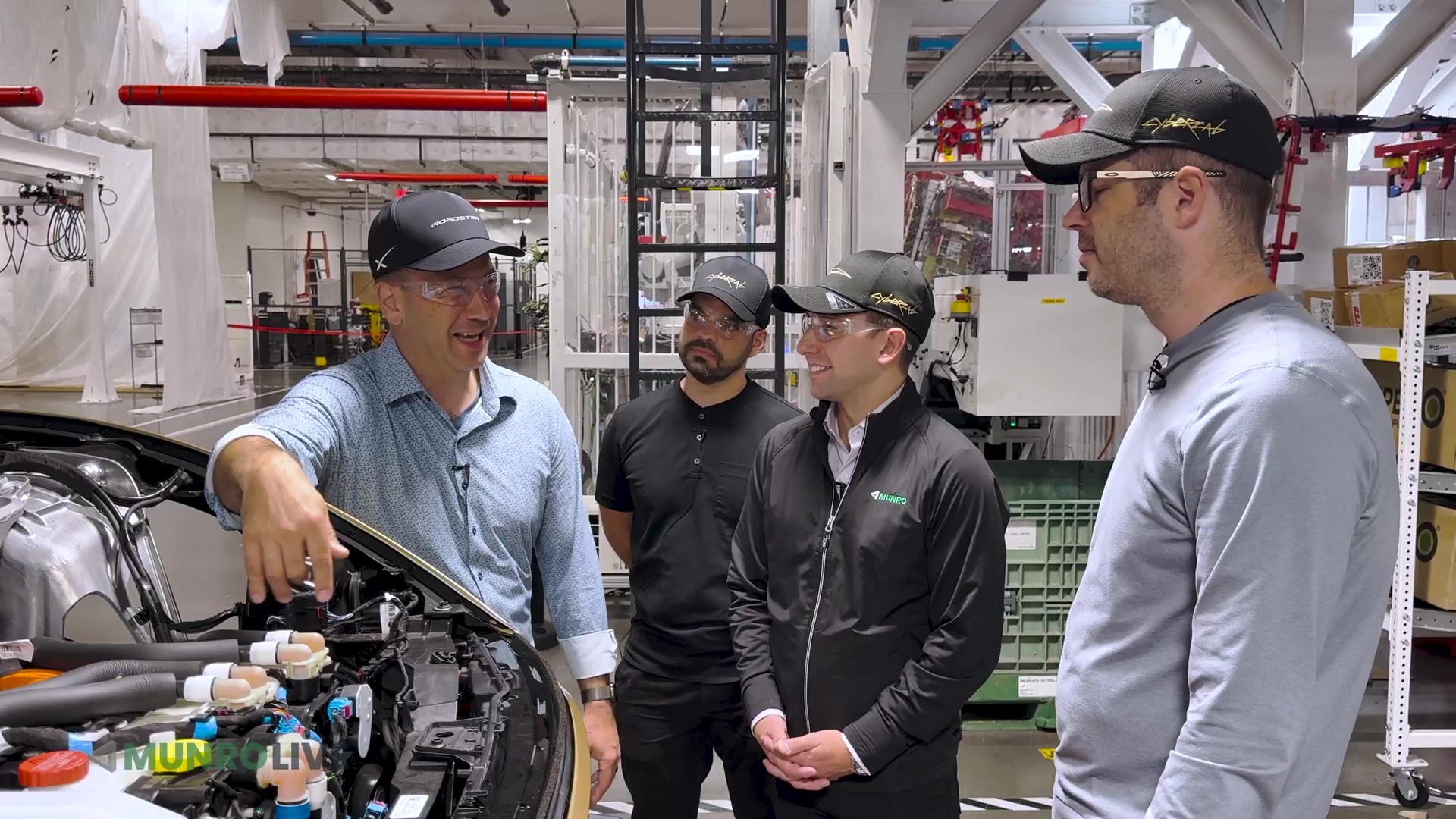
Image: Munro Live/YouTube
Tesla’s Cybercab factory line can now build the two-seater faster than the company can put it on the road, according to Lars Moravy, Tesla’s vice president of vehicle engineering.
Speaking in a new Cybercab engineering deep dive from Munro Live filmed on the line in Texas, Moravy said, “We don’t run every day because the line can run so fast, it’s currently outpacing our deployments.” That goes a step beyond what he told analysts last week, when he said the Cybercab has half the parts of any Tesla and its line can go faster than its listed capacity.
Moravy called it “a bit of a race right now” to see which side goes faster, adding that “right now, the manufacturing line’s ahead.” The official Robotaxi account shared Munro Live’s announcement of the full video on Monday, calling it a “Cybercab engineering deep dive.”
Key takeaways on Cybercab
- The line can build Cybercabs faster than Tesla is deploying them, so it doesn’t run every day.
- Tesla is targeting a 10-second cycle time with 100% automation. The line is about 78% automated today, and the framing line is already fully automated.
- Final assembly takes just 25 automated stations, versus five to 10 times that on a typical Model Y line.
- The layout uses about 50% less floor space per vehicle.
- There is no paint shop, and the car is built to run at least half a million miles.
- The 4680 battery pack sits in a steel enclosure with wireless battery management and no pyro fuse. Tesla’s battery director graded it an A-minus, versus a D for the Model Y structural pack and a B-minus for Cybertruck.
- The drive unit uses an 11:1 gear ratio, and a lubricant change later this year cuts gear mesh losses by 7%.
- Asked when Munro Live gets a Cybercab to tear down, Tesla’s answer was “Not yet.”
Munro Live walked the plant with Moravy and members of his engineering and manufacturing teams. The whole design starts with what Tesla calls unboxing, which breaks the car into front, rear, side and center modules that are built and tested on their own before they meet. “We kind of hit a wall where like the problem wasn’t the automation, the problem was the design,” Moravy said, explaining that the idea came together about five or six years ago.
Because each module arrives already tested, final assembly takes just 25 fully automated stations, and the team said a typical Model Y line has five to 10 times that many. The full Cybercab line sits at about 78% automation, and engineers said they are working to push that higher. The framing line Munro Live toured is already 100% automated, right down to robots that feed parts to it. Engineers also said the layout uses about 50% less floor space per vehicle built, which was a target from the start because Tesla wants to build “thousands and thousands and thousands of these a week.”
Driving those choices is a 10-second cycle time target, meaning Tesla wants a finished Cybercab rolling off the line about every 10 seconds. A Tesla engineer said the goal of “100% automation in 10-second cycle time” forced “a really intense focus on simplification,” with the team deleting a lot of parts and integrating the rest.
No paint shop and a car built for half a million miles
Tesla also deleted the paint shop. Only the side modules are coated, while the aluminum front and rear modules skip e-coating altogether, and the body panels get their color inside the molding machine instead of in a paint booth. “Rule number one of Tesla, question the requirements. Why do you need paint?” one engineer said. The team added that the car is designed to “run half a million miles at least,” which matters for a vehicle that will spend most of its day carrying riders.
Under the floor sits an 88S 6P pack of 4680 cells with a steel enclosure, a first for this program, and cells potted module by module instead of across the whole pack, so service crews can swap a single module. Tesla’s battery director graded the Model Y structural pack a “D” for how hard it was to build and the Cybertruck pack a “B minus,” then gave the Cybercab pack an “A minus.” The pack also uses wireless battery management boards and fast contactors that let Tesla drop the pyro fuse, and it leaves room for lower energy density chemistries such as LFP. Tesla recently built its first Cybercab using in-house cathode material, part of the same push to own the supply chain.
Up front, a new drive unit runs an 11:1 gear ratio, compared with about 9:1 on most Teslas, since the Cybercab does not need a high top speed. Its head of drive units said the new inverter power stage will also ship in other Tesla vehicles this year and can be swapped into a Model Y drive unit, and that a lubricant change later this year will cut gear mesh losses by 7%. The thermal system moves most of its complexity to the coolant side, building on what engineers called 100 billion miles of heat pump experience across 9 million vehicles.
Inside the Cybercab battery pack
Battery cells and the electronics around them often make up a quarter to a third of a vehicle’s cost, Tesla’s battery director told Munro Live, which is why the team chased cost of ownership over raw range. Here are the biggest changes:
- Swappable modules: Potting cells module by module means a single failed module, “worth, you know, 1,500 bucks a piece,” can be replaced while the rest are salvaged. Replacing a whole pack before half a million miles “is a killer on cost,” he said.
- Wireless battery management: Each battery management board now has an RF chip instead of a wiring harness. The chip adds 20 to 30 cents, but it deletes a harness worth about $1 plus roughly 50 cents of assembly, and it adds local compute for runaway detection.
- No pyro fuse: New interrupting contactors, covered by a Tesla patent application, are fast enough to replace the pyrotechnic fuse and can open under load several times and keep working. That matters because many pyro fuse trips come from low-speed crashes where the high-voltage system is still healthy.
- Serviced from below: The electronics sit inline and drop out from the bottom like a platter, since Tesla’s service data shows the cells and modules are far more reliable than the electronics.
- The pack is the floor: The pack’s top cover doubles as the cabin floor, with seat crossmembers welded directly to it, and it is one stamping with the electronics housing. Model 3 and Model Y need a separate wall, seal and bolts there.
- Crash support: In a side-pole impact, the modules act as stiff backup structure that spreads the load across five longitudinal paths without crushing the cells, making the pack semi-structural.
- Fewer connectors: The battery control unit mounts straight to the contactors, and a single casting with built-in connector shrouds replaces panel mounts and jumpers.
Built for a race Tesla expects to win
Production is ramping alongside the service itself. Tesla sent more than 50 Cybercabs to the Austin F1 weekend, and an engineer on the tour said that downtown, “you literally will see four cabs in a matter of 30 seconds no matter what direction you look.” The Tesla team argued that owning everything from raw materials to charging, service and the app is why competitors will struggle, since for riders “it’s just going to come down to cost per mile.”
Tesla said on its Q3 2026 earnings call that Cybercab service will launch in Dallas next month, so the deployment side of Moravy’s race should pick up soon. Asked when Munro could get a Cybercab to tear down, the team answered, “Not yet.”
Do you think Tesla’s Robotaxi rollout can catch up to how fast the Cybercab line can build cars?