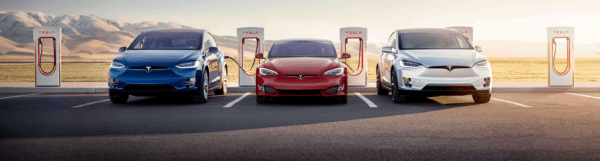
Tesla is reportedly set to upgrade its V3 Superchargers across North America to charging speeds up to 324kW from the current 250kW, according to a report from insider @Sawyer Merritt on Sunday evening..
Following the upgrade, according to Merritt, Tesla will begin to unveil its V4 Supercharging hardware soon after the update, expected to debut in Q3 of this year.
According to Canadian Supercharger sleuth, @MarcoRPTesla, the user reported hearing the upgraded speeds would reach 370kW, from an unnamed source on the Supercharging team.
In either case, the upgrade would speed up the time it takes to Supercharge, and help alleviate line ups and congestion at the busiest locations.
The news also comes ahead of Tesla’s apparent plans to open its Supercharger network to other EV brands, a plan which the company announced last year.
While Tesla has already deployed the new feature in the Netherlands, it’s not yet clear when the U.S. automaker plans to unveil this change around the world.
Last week, Tesla unveiled a number of new Supercharger stations, including new locations in Japan, Australia, Canada and the U.S.


It seems inevitable that Tesla will upgrade/equip all of their V2/V3/V4 Superchargers with the addition of CCS-2 charging cables, and that will enable them to eventually open the entire Supercharger network to non-Tesla EVs, even in North America (each EV will need its own “www.Tesla.com” account with a valid funding source).
CCS-2 is required for all new EU BEVs, is rated for 500kW/1000Vdc and supports V2G/V2H/V2x. It stands to reason that extra-fast-charging for the upcoming Cybertruck and Roadster II is going to require CCS-2, since the elegant, compact North American Tesla plug is maxxed out. A CCS-2 jack is required for those vehicles to be sold in the EU anyways.
I’m guessing that the upgrade from 250kW to 324kW applies to V3 Supercharger stations and that the upcoming V4 Supercharger stations will support the higher 370kW charging rate, if those numbers are accurate. Some of the latest CCS-2 charging stations are capable of providing 350kW of dc rapid charging. To date (2/2022), no “consumer” BEV is capable of dc rapid-charging faster than 350kW, and that’s only for a relatively brief period to minimize battery pack degradation. If it could be accepted and sustained, that amount of power (350kW) could theoretically charge a completely-depleted 100kWh battery pack in less than 18 minutes (a very unlikely scenario). In practice, the charging tapers required to minimize long-term degradation of current battery pack chemistries increase the required charging time to an hour or more.
In principle, BEVs with 800-1000Vdc battery pack designs have charging advantages over those with 400Vdc designs due to lower I*I*R (current-squared) heating. This is offset by the added expense of vehicle electronics, cabling and other components designed to operate efficiently at these higher voltages. The Tesla Model S was introduced in 2012, and the decision to adopt 450Vdc rapid-charging for the Tesla Supercharger network was revolutionary.
Higher-power, higher-voltage EV charging standards and equipment will be developed and adopted for commercial trucks, buses and other large vehicles to enable faster charging. Modern power grids operate at very high voltages for similar reasons, stepping down to lower, safer voltages for end-user consumption. A new Tesla Model S/X Plaid has a 100kWh battery pack with 7920 battery cells at a nominal 4.091Vdc each that could theoretically provide 32,400Vdc if they were all connected in series, but failure of any one connection or battery cell could cripple this entire pack. Instead, they are arranged in five 22S72P modules, 110 series-connected “bricks” of 72 parallel-connected battery cells, yielding a nominal pack voltage of 450Vdc.