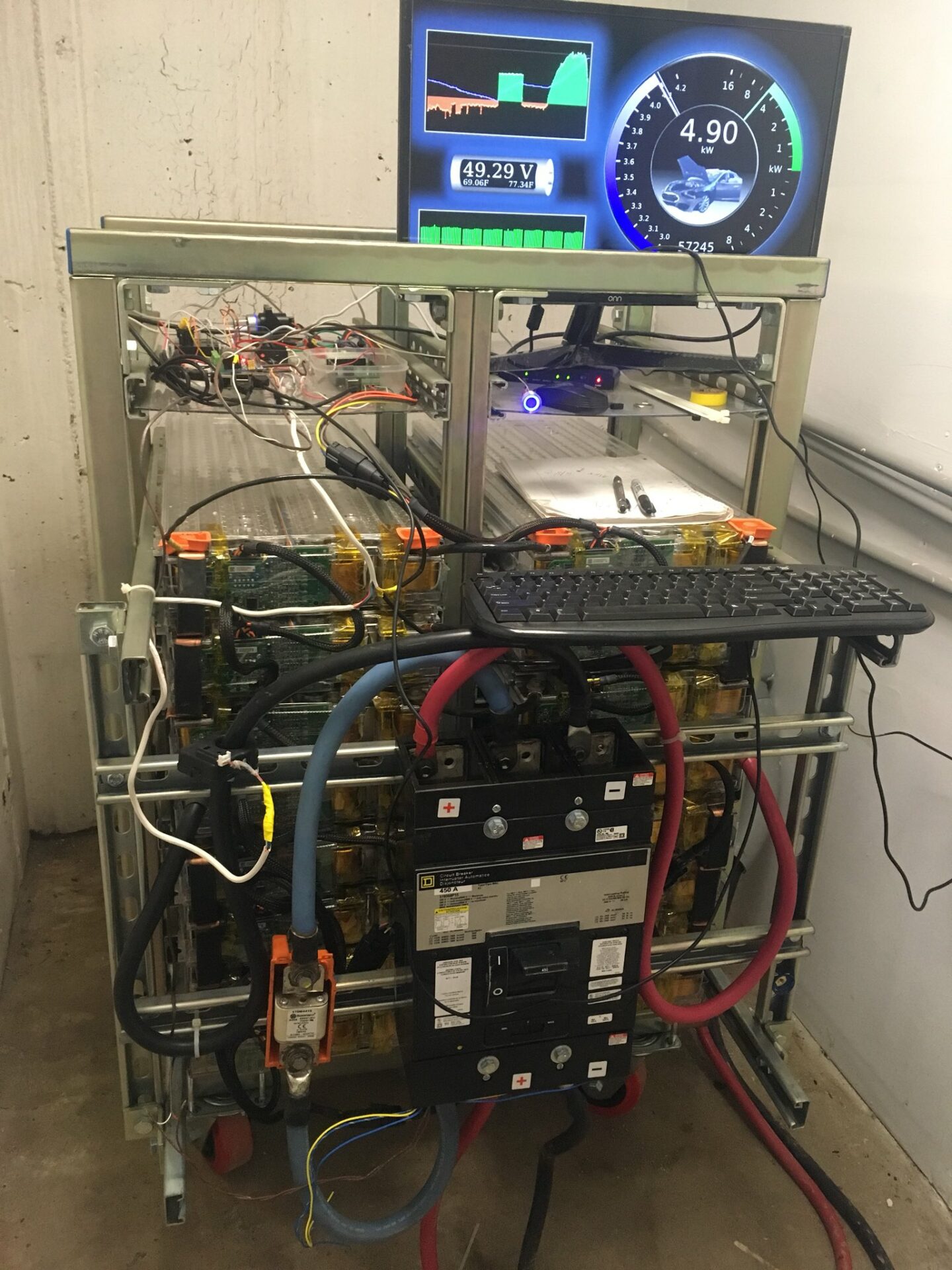
Image: @RepThomasMassie on Twitter
Thomas Massie, U.S. Representative for Kentucky’s 4th congressional district since 2012, revealed in a recent tweet that his entire house has been running on a battery salvaged from a totalled Tesla Model S, 24 hours a day for the last four years with zero interruptions.
The salvaged battery is recharged every day by a total of 69 solar panels that produce around 17 kW worth of power, explained Massie. The businessman turned politician added that the Model S battery has the same capacity as “about 6 Powerwalls,” one of which alone can comfortably power your average home for over two days at full charge.
That’s pretty accurate — the Model S P90D’s battery is rated at 90 kWh of capacity, whereas one Tesla Powerwall stores 12.2 kWh of usable energy while maintaining a 10% reserve.
Massie, who holds a Bachelor’s degree in Electrical Engineering as well as a Master’s degree from MIT, jerry-rigged the power storage and distribution system himself.
“Everything in our house, including geothermal heat-pump and deep freezer (full of grass-fed beef we raised), is running on this rekt ModelS Tesla battery right now,” Massie said in a tweet from 2019. “I built it & programmed it in C on a Pi.”
Massie’s strong opinions on healthcare and other subjects aside, the setup is pretty impressive. It also goes to show just how sustainable electric cars are — even if they get totalled or reach end-of-life, their batteries can still be used to power entire residences.


“Massie’s opinions on healthcare and other subjects aside” What the heck does that have to do with his system? Some sort of side slap because of politics? Who cares? This is about alternative RE, how it can work for those of us who might still doubt the technology. He sounds like an interesting guy.
I think its just a remarkable point that there exists a Republican that embraces science and green energy — it’s both refreshing and rare these days. That’s all.
There is this big tendency for us all I guess to wrap people in white or black and “nary the twain shall meet”. It’s too bad really because it really lessens what we all are…..much more than our pigeon holes.
I am not concerned with Massie’s politics, but his engineering skills.
The Massie data does not tell the full story. It is too incomplete to know what it really means.
What is the daily energy demand of his home, on an annual basis, under typical varying conditions? What is the capacity factor of his solar panels from summer peak to winter minimum (it varies by at least a factor of three). The part of KY where Massie lives has 75 CLEAR days a year, and 100 partially clear days. That means Massie has a summer excess of power on those 75 clear days that he must send to the grid or use to heat water. It HAS to go somewhere. Does Massie draw back the same power in winter to make up the nighttime AND the winter deficit. Can that be self-sustaining? That works in the summer because he has the grid available. His one Tesla 85 KWh battery (effectively 60 KWh) can store about 1/2 the full output of his 17kw nameplate PV for ONE peak summer day, so he must send most of his power to the grid. Massie is paid by the power company about 1/3 the current power cost for this service, but that net loss is not mentioned.
In winter, when his need for power (heating with an electric heat pump) is greatest, the output of the 17 KW name plate PV is only 5 KW on a clear day, so he is short of the power to run more than during the day and can store NO power for the night. IF his home (doubtful) has the typical single family home electrical energy demand, averaging about 30 KWh daily, then he can get by in the summer, with one following cloudy day, but by September, he must be drawing from the grid and continues until April. The electric heat pump has its greatest draw in winter.
The claim of a four year period of independence (not independence from the grid, you notice) is not supported by the data he gives. In winter with a week of cloudy weather (often occurring in KY), he freezes.
The cost of his system is also not mentioned. A simple calculation and a look online for salvaged Tesla batteries, plus the ground exchange heat pump system cost Massie at least $130,000. That is half the price of many people’s HOMES in Kentucky.
For Massie’s system to be truly self-sustaining, he needs at least 8 Tesla batteries and at least a three times larger PV component.
Pretty soon, we will talking REAL money.
One final point, Massie could do a lot better by off-loading most of his heating to a CHEAP, passive hot water system, with a large underground reservoir, but that is not NEARLY as sexy as having a Tesla battery in the basement and a couple more in the Garage (in his Teslas).