Tesla today detailed its vertical integration benefits at its Battery Day event, where the company will halve the cost of batteries, lower the cost of dollar spent per kilowatt hour and also reduce investment per gigawatt hour.
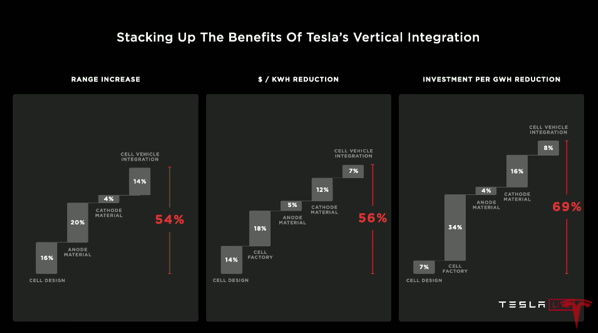
When it comes to range increases for Tesla vehicles, the company will see savings from its cell design at 16%, 20% in anode materials, 4% in cathode materials and 14% from its cell vehicle integration. The total savings will result in a 54% range increase for its vehicles.
For Tesla to reduce its dollar per kilowatt hour cost by 56%, that comes from a 14% savings in cell design, 18% from its own cell factory, 5% savings in anode material, 12% savings in cathode material and 7% in cell vehicle integration.
To reduce its investment per gigawatt hour, the company will see savings of 69%, based on 7% savings in cell design, 34% from its own cell factory, 4% savings in anode material, 16% in cathode materials and 8% in its cell vehicle integrations.

