Elon Musk’s Full Ron Baron Interview 2026: Tesla, SpaceX, Starship, AI and More
Read Elon Musk's full November 6, 2026 interview with Ron Baron covering Tesla, SpaceX, Terafab, Starlink, Starship, Optimus and AI.

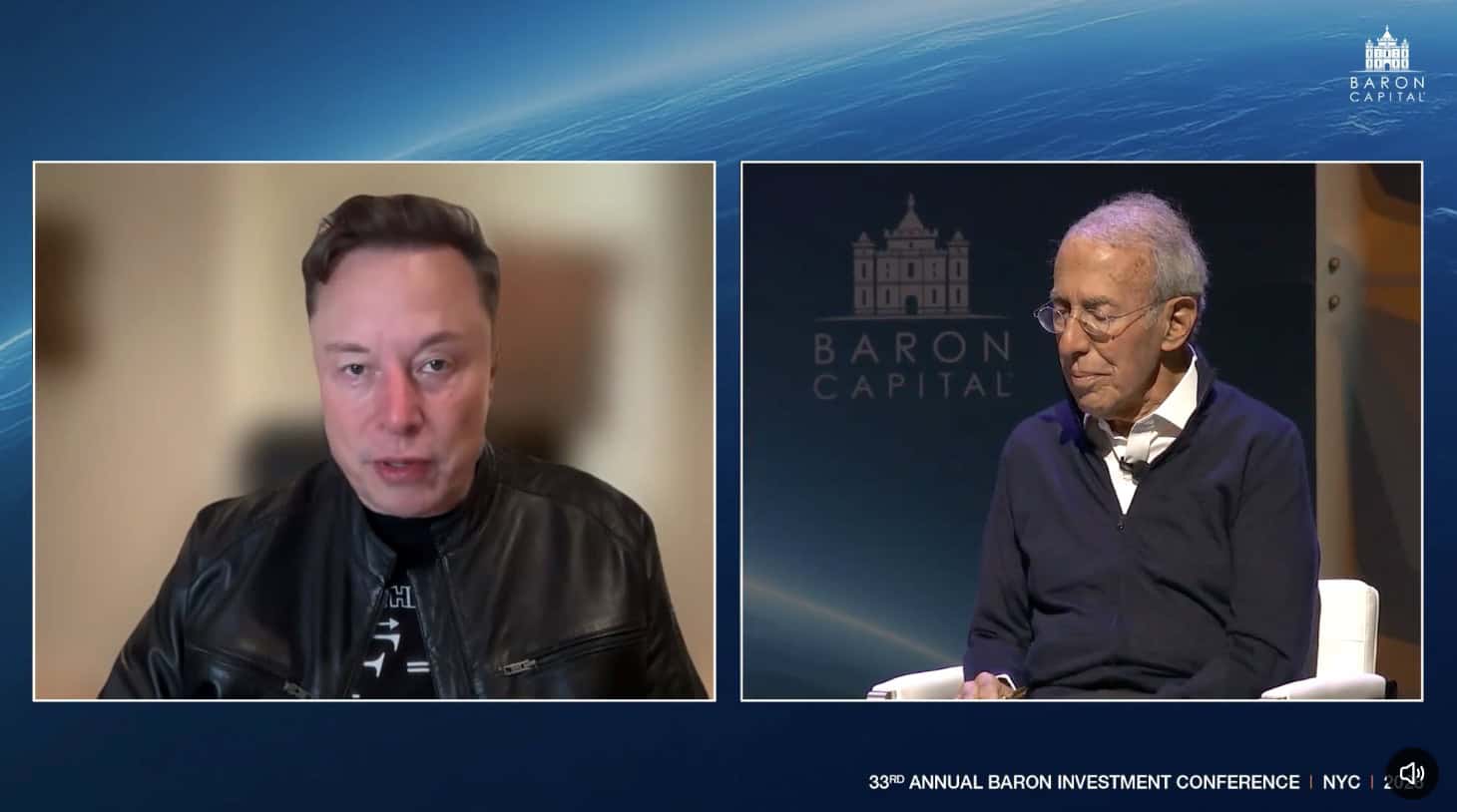
Elon Musk joined billionaire investor Ron Baron for a wide-ranging conversation at the 33rd Annual Baron Investment Conference on Friday, November 6, 2026, discussing Tesla’s Terafab semiconductor project, SpaceX’s growing AI ambitions, the next Starship catch attempt, Starlink satellites and Tesla’s Optimus humanoid robot.
The virtual fireside chat was scheduled for 1:10 p.m. ET at New York City’s Lincoln Center. Musk said the companies are exploring production of AI chips on a massive scale, launching StarMind computers into orbit beginning as early as 2027 and dramatically increasing Starlink’s bandwidth. He also floated the possibility of acquiring an established telecom company to gain more spectrum.
Baron is one of Musk’s longtime financial backers. His investment firm began building its principal Tesla position from 2014 to 2016 and started investing in SpaceX in 2017.
In an April 2026 shareholder letter, Baron said his SpaceX investment was worth roughly $15 billion at the time, while his Tesla holdings were valued at about $4.7 billion. According to Baron Capital’s September 30 disclosures, SpaceX accounted for 32.6% of long positions in Baron Partners Fund and Tesla for another 13.4%.
The interview touched on subjects previously covered by Tesla North, including Musk’s return to Baron’s conference, Starlink V3 satellite deployment and Ship 42 tower testing.
Watch the full conversation below, followed by a transcript organized by topic.
Transcript note: It has not been checked word for word against the video. Some passages, names and figures may be misheard; confirm any quotation against the recording before republishing it.
Interview Topics
- Opening and Ron Baron’s investment philosophy
- Terafab and U.S. semiconductor manufacturing
- Chip manufacturing efficiency and the Texas research fab
- Tesla, SpaceX and Musk’s engineering culture
- Musk’s hands-on approach to AI infrastructure
- OpenAI, Anthropic and the origins of xAI
- AI data centres and SpaceX financial projections
- Optimus humanoid robots and productivity
- Data centres and local communities
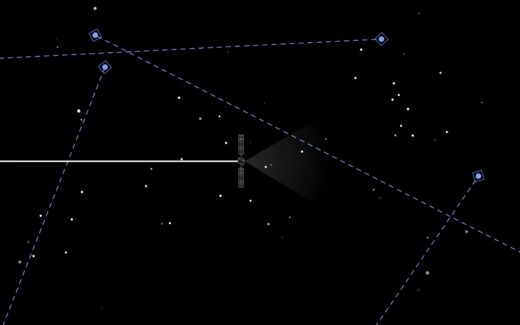
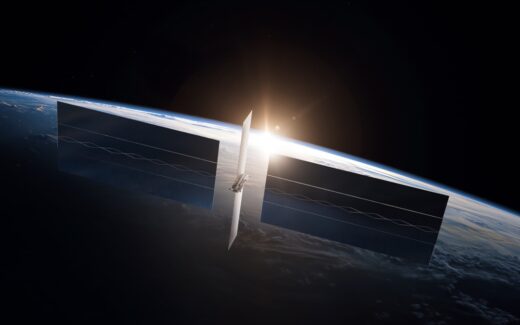
- StarMind and orbital AI computing
- Starship launch costs and reusability
- Starship upper-stage catch plans
- Starlink’s expansion and AI traffic
- Telecom spectrum and possible acquisitions
- Competition with China
- Artificial superintelligence and the economy
- Closing remarks
Elon Musk’s Full 2026 Ron Baron Interview: Tesla, SpaceX, Starship and AI
Opening and Ron Baron’s investment philosophy
Elon Musk: Yeah. Yeah. There’s lots of exciting times ahead.
Ron: That’s for sure. Yeah, I’d say. So.
Elon: We’re living in the most interesting of times, I think.
Ron: I think so too. You know, When I was preparing for this conversation. One of the things I just visualized was E. T. So E. T. going across the moon, you know, with a boy on a bicycle and a contraption to communicate to call home. Obviously, a predecessor to Starlink. So I guess that didn’t work. So Elon has uses the principle, you know, first principles. About everything should be done the right way, not the fastest way, not the quickest way, not the cheapest way—the best way. And everything looks at all over again. So, if someone makes an investment on his behalf for one of his businesses, It’s always viewed in the terms of: Is this the best we can do?
Ron: Best we can do, the fastest we can do, the most effective. So, so one thing I would say is that he’s a builder. He’s probably the only builder I’m aware of, United States, who builds stuff, But builds stuff that’s not just regular stuff, like 10 million square foot buildings, 5 million, 20 million. Now he’s got 100 million square foot building for TerraFab that he’s thinking about or going to build, And so the question, and no one else has done this, no one, And anything like it. And so the question is, of course, and when you’re doing such a thing. Then you get scaling benefits. You get to buy things, And produce things much more effectively than you could if you were a smaller entity. So, question is,
Ron: How do you manage to do this? And why didn’t anyone else ever try to do anything like this? We’re trying to get silicon to come back to United States again. We need it. We need power. We need silicon. No one’s doing this except for you. How come?
Terafab and U.S. semiconductor manufacturing
Elon Musk: Well, that’s actually that’s not quite accurate. In that. TSMC and Samsung are building fabs in the U. S. So TSMC is building a large collection of fabs in Arizona, and some of them are, I believe, operational. And Samsung has some operational fabs in Texas, and is is building or has built, I should say, a fab for for Tesla that will be dedicated to the AI five and and AI six chip designs that Tesla’s done. So, But relative to what’s being Done in Asia, the amount of chip fabrication in the U. S. is very small. And even if you take the best-case assumptions of all the chip fabs that that have been announced that will be built in in America, that’s still a tiny fraction, perhaps on the order of 10 percent, optimistically 10 percent of what’s in Asia. So,
Elon Musk: As I think most people know, Taiwan does an incredible amount of heavy lifting on chip production. TSMC is an amazing company. Truly incredible—the sheer number of a variety of chips and the magnitude and the volume is incredible. What that TSMC does, same thing for Samsung, And and and I think Micron does does a great job too on the memory side. So, But the but it’s overwhelmingly built in Asia. The so so my my concern really is. There is always like some geopolitical risk in that region, and I think that that risk may come to fruition at some point. In which case, If if we don’t have all the pieces necessary to build chips at scale in America, Then we may not have any chips at all, or very few, the ten percent number type of thing.
Elon Musk: And and then there’s the the maybe looking ahead, You know, past any sort of. Medium-term geopolitical bumps in the road. We’re we’re simply even if if you exclude geopolitical crisis issues, The rate at which we’re making chips is simply too slow. So if you if you want to get to say a terawatt a year of chip production, which is our goal, that’s the reason it’s called the the terafabics. Sometimes people when I say terafab, there’s you know three possible meanings to terafab. One is terror, T E. R R O R, Which I think sometimes people like. Why would you want to terraform? Oh, and then there’s T E R R A, which just means Earth, But it’s actually T E R A,
Elon Musk: As in terawatt. So, but arguably, all three apply. So, It’s terrifyingly large. So, So, so. The rest of the world is making. We’ll make this year around twenty gigawatts of AI chips, maybe twenty-five, And then next year, depending on whose projections you believe, it’s maybe around thirty-five to forty-five gigawatts of of AI chips next year. And but but if if you want to do a terawatt, that’s now you need you need thirty times what current. Global production will be roughly next year.
Ron: For just us, We’re building that for us.
Elon Musk: Well, yes, we’re building.
Ron: I mean, we could sell it to other people too, but basically, we’re building 30 times what the annual production is in one plant, Which you think is going to do as value, as big a production as the GDP in the world, as the GDP for the 20th largest country, one one plant.
Chip manufacturing efficiency and the Texas research fab
Elon Musk: Yeah, it might even make the top 10. So. Now, now, obviously, you know, a plan like this. I think if if it if it fails, it’ll be crazy, and if it succeeds, it’ll be audacious. So it sort of depends on the outcome. I think it will succeed at least to some degree.
Ron: Hope so. Yeah, yeah. I mean, it’s going to cost a trillion dollars.
Elon Musk: But we won’t need that money immediately. We’ll be building phases, And we are looking at ways to change the manufacturing process for for chips to improve the efficiency of chip production, As we’ve done in many other arenas. You know, like just one example, like like right now, The amount of time that a wafer in a chip fab spends simply being transported and waiting is more than half the time. So more than half of what a chip is doing in a chip pad is nothing. It’s it’s either being moved around or or waiting for a machine. So, And and I think I think there’s just basically a lot of a lot of potential for improvement in chip fabrication.
Ron: Why don’t these people do it themselves? If they’re if they have plans, just sit with chips half the time, just not moving. What’s to stop them from improving their own systems?
Elon Musk: Well, no, actually, if you if you visit a fab, You’ll see that the wafers are moving a lot. They’re zipping all over the place, and and waiting. But but but the amount of time that that atoms are being changed on the wafer in a way that is useful is less than half the time, And I’d say sometimes it’s maybe twenty percent of the time that something useful is happening to the atoms on that wafer. The the the reason that they don’t want to try something adventurous or with with chipabs is that these things cost a tremendous amount of capital, And and and if they have a recipe that works, they just they simply don’t want to risk something new. So, Generally, the preference in the chip industry is to repeat what they did last time with minor changes,
Elon Musk: And and not. Taking new risks, So we we’re building a research fab in Texas, just in Austin, At the at Gigafactory Texas. That research fab is going to try many different approaches to chip fabrication, And and many of those approaches won’t work, but some of them I’m sure will work. And then we will translate those improvements to the the terabat itself, the production terabat, Which is in Grimes County in Texas, near Texas A and M, and and that’s where we’ll scale up production of our AI chips. I think one of the things that’s going to be interesting about the research fab in Austin is that I wonder if we will have the ability to make a do do. Logic, memory, packaging,
Elon Musk: And do the lithography, So so that we can have we can design new chips, And and under one roof, Make the make the whole chip tested, make the whole chip tested, With a very fast iteration cycle. Something that would normally take a year, I think we we may be able to reduce to a month. So, if For any given technology endeavor, the the pace of progress is determined by how many how many iterations can you do, and how much progress can you make between those iterations. So, if if you can improve the speed of iteration, And the and the and like how how many iterations can you do per year or per unit time, and the progress between each each iteration in any given technology, you will you accelerate your progress at a rate far greater than Anyone else? If you are,
Elon Musk: You know, if you’re able to iterate an order of magnitude faster, you, As a first approximation, will advance your technology an order of magnitude faster.
Tesla, SpaceX and Musk’s engineering culture
Ron: So, so most people are. There’s a tremendous amount of inertia in in business because if someone makes an effort to spend money and it’s not successful, Then that’s a black mark on them, And if it is successful. And they’re trying to get the top job of the business. Then it just means that they have to work harder. So if they’re successful, they work harder. And if it if it fails, They’re finished for their opportunity for the top job. Elon has established a culture in his business businesses where it’s always about come to me with ideas, and then if it’s success, if you if if you think it’s successful, and I believe that’s the case. Then we’ll throw away what we’ve done before and start all over again. It’s always about doing the best thing. One of the things that’s interesting to me about your culture is that you introduced me to Key Luck, the person who’s in charge Intel,
Ron: Who’s now going to be have an interest in Terrafab, And so I spent some time with him. And he comes to visit me, and I said, “So, so what’s it like to work with Elon?” He says, “Well, other people come to visit my facility in Oregon, And they come and they walk around for an hour and a half, and they leave. And Elon comes, and then he sits there. He was there for four and a half hours, And he interviews one engineer after another, questioning everything. That’s the whole concept. So everything that he has to do is speed. And then when I went to Texas, to Boca Chica, To visit their car factory that they were building there.” They while it was under construction,
Ron: They introduced me to the head of that facility, the manager, Giant man, And and of course everyone seems like a giant to me, but he was he was a really giant guy, and he had been previously the head of production at Ford, And so I said, well, so what’s it like, Difference between Ford and Tesla? He said, well, when I was at Ford and I had a change, I had to go through six different levels to get a change approved. When I have to have a change here, then all I do is walk upstairs, and there’s Elon. And so, when a plan to something under construction, Elon’s not some distant guy; he’s there. He even has an airstream. He lives in an airstream. Do you know any other executives of any big companies,
Ron: Potentially the largest company in the world, going to live in an airstream to make sure that all the questions that are taking place in making a facility are going to be answered fast? So, you know, it’s amazing culture. An amazing person, That, and amazing people who’s recruited. So this whole people who work there, they’re just brilliant people. It’s like harder to get a job there than get into Harvard.
Musk’s hands-on approach to AI infrastructure
Ron: Of course, I don’t know why people are going to Harvard anyway anymore.
Elon Musk: Well, by the way, Eskimos are actually pretty nice, so I wouldn’t say I’m like. Not that bad, honestly. I kind of like my little Eskimo. But it’s it’s actually parked right next to the power plant that we so we built this power plant that’s producing over a gigawatt, And probably it’ll you know go to one and a half to two gigawatts of internal power plant production in about a fifth of the time that such a thing would normally be built. So built in about a year, As opposed to normally about five years for that. And it’s not it’s not as though somebody has to come to me. Upstairs, there there is no upstairs, so we have no upper floor. In in the around Memphis, we lost this two thing.
Elon Musk: I walk I walk the entire site, Sometimes two, sometimes three, sometimes four, five times a day. So the entire site, the power plant, and all the buildings. And I also insist on doing at least some of the work myself manually. So so I like I. Full power cables the size of a anaconda, Like they’re incredibly heavy, and long. And I’ve I’ve done the fiber optic cabling. I’ve done electrical switches. I’ve worked on the on the power plant management software. So I try to do at least a little bit of everything, so that I’m not numb to the pain of the people who are actually doing it. And I have some. Understanding of the difficulty and what can be done to improve the situation.
Elon Musk: So it’s not as though I’m sitting in an office and somebody has to come to me. I’m walking the floor, asking them questions actively.
Speaker 1: It’s amazing.
Ron: So let’s talk a little bit about data centers, which are now in the news, And people.
Elon Musk: Yeah, popular topic. How to how to how to make friends and influence people, you know, Data centers are. You know the pitchfork level for data centers is pretty high.
Ron: Yeah, I say. So so, But but, But but if you want to have AI, you got to have data centers, And so let’s talk about them first on this planet. So so, Elon believed that the the roadblock that would be in the way of data center construction would be having enough chips. Enough compute, actually, And so, so what he did is that a lot of people we have Grok, so he was at the forefront of OpenAI, of Anthropic. Those guys are his guys, and then, of course, it doesn’t like OpenAI anymore. But yeah,
Elon Musk: Well, I did start OpenAI as an as an open source nonprofit, and now it is a closed for maximum profit entity. So it’s literally the polar opposite of what I started. Right. And then Anthropic was founded by seven people that left OpenAI because they were they didn’t trust Sam Altman for good reason. They said this publicly. This is not a secret. And and so effectively, Anthropic is an offshoot of OpenAI. Fuck.
OpenAI, Anthropic and the origins of xAI
Elon Musk: So yeah, it’s. I guess I should have just started OpenAI as a regular sequal instead of as a as a nonprofit. But you know, I thought this would be something that would be a philanthropic thing for the world. I didn’t anticipate it would one day turn into a a for-profit that is closed source.
Ron: And when you left because you were disappointed in the direction, they offered you an ownership interest, and you said, “No, I don’t want it, ” And so you left. Well, yeah, I mean, well,
Elon Musk: I was confused as to how you could have a commercial interest in a nonprofit. That that didn’t seem to make sense to me. I, you know. You know, I provided almost all the capital in the beginning for the company. It was my idea, and I named it, And recruited the key people, and taught them everything I know. But apart from that, nothing.
AI data centres and SpaceX financial projections
Ron: So to go back to data centers, so you thought that the idea about putting all this AI in operation was we need data centers, and people want to build them, And it takes them ordinarily. About two and a half years to build one, And it costs maybe sixty billion dollars to build it. Fifty or sixty billion dollars to build a gig, And then the people who build them for hyperscalers and rent them, in order for them to get the capital, they need to borrow it or get it in some way that they have to have long-term leases, five years at least, to get them. So the rents people pay in five-year leases are maybe twelve billion dollars a year for sixty billion-dollar investments.
Ron: What we do instead is that we build them, and we build them because we have use for them, Because we’re vertically integrated for our cars, for our robots, For our rockets, For for everything, And and because we need them, then we can take risk of building them without knowing that we have contracts for other people. And what happens though is we have them built, And They’re not so it takes us somewhere. It was taking us four months. It’s now taking us eight or nine months to build. So it takes them two and a half years. Takes us eight months, nine months. Costs them sixty billion. Costs us thirty-five billion. And the demand for compute is so great that people who built centers are dark because they don’t have the power to turn them on,
Ron: And and we’ll rent them to compute until we need it for ourselves for GOC, And we’ll rent it to them for. For somewhere around 50 billion a year, So we’re getting 50 billion a year for 35 billion dollar investments. So the revenues for SpaceX are about to explode,
Elon Musk: Going up. Yes, they are exploding. So I think yeah, our Q2 to Q3 revenue increase was I think over 80 percent this year. I’m not sure what the exact numbers will be Q3 to Q4, but but probably something like 70 percent. Q3 to Q4, and I would, I would say maybe it’s something similar, you know, Q4 to Q1. The like it is extraordinarily difficult to bring on compute at scale. It’s it’s, And I think there’s a lot of speculators out there who think you can simply order some GPUs, Hand hand a purchase order to some company to build a data center and just rake in cash. And the reality is, it’s insanely hard. So there’s a meme that I think is quite funny, Which I think is called the Jose meme,
Elon Musk: Where there’s you may have seen it before that there’s one guy digging the hole in the road, and there’s like eight people watching him dig the hole. So now, meaning like there’s one there’s one person doing actual work, and one and then eight people watching the guy do the work. Now. Unless you increase the number of Jose’s in in the country, then the amount of work done does not increase. And so, adding more people who who simply, You know, issue purchase orders to Jose does not result in more things occurring. Only if there are more Jose’s, more work. So, I aspire to be Jose. Space SpaceX wants to be is Jose. We do actual work. This a this a really big deal.
Elon Musk: And and. And with the massive expansion and construction in the United States, the frankly, it’s not as though there’s been this massive influx of people who do actual work at a physical level, But there’s been a massive increase in the number of people who issue purchase orders. So that means that the people doing actual work are spread incredibly thin, And so you have a large number of partially completed data center projects throughout the country because at this point, the peanut butter is spread so thin you can barely taste it. The the the difference is that SpaceX we actually are used to doing incredibly challenging physical work in terms of building giant rockets and vast launch complexes and Tesla is also very good at large scale construction and probably the two best companies at physical hardware on Earth outside of China are SpaceX and Tesla.
Elon Musk: I don’t even know who would be number three. And and you know I think even Tesla might be the best in the world, even including China, Where China is incredibly good. But it’s worth noting that you know the Tesla Model Y is the best-selling EV in China.
Ron: Well, you taught them a lot in China.
Elon Musk: This like this like you know winning a land war in Asia classically difficult, And and yet we we kind of are actually in in that Model Y is the best-selling car in China. Think about that for a second. And let me tell you, the Chinese car companies are super good.
Ron: Yeah, the person from Ford went there. He said he was blown away by the quality of the cars in China.
Elon Musk: Yes, partly. China’s awesome. I love China, by the way. It’s inspiring to go there.
Ron: Well, most people who build in China they have to have Chinese ownership of a significant portion of the operation in China, And they were so anxious. Forty-nine percent is what you’re allowed to own in China normally. And Tesla, they wanted us to be there so badly that they let us go one hundred percent ownership for us. Yes,
Elon Musk: That took quite a few years of meeting with with Chinese officials, and I actually, you know, some of the people in the government actually, you know, they actually literally yelled at me, Like spit flying type of thing that that we had to get sort of. You know, married to a Chinese partner, and I’m like, well, we’re just a baby company, and I don’t think babies should get married. You know, because I would look funny going down the aisle with a baby, and they’re and they’re like, you’re not a baby. I’m like, no, we’re we’re a baby, and you know, babies should just you know not get married. It’s too young. So they eventually they said, okay, fine, we’ll we’ll change the law, and then you can own the factory, and mostly it was like we just need to be able to move fast. And make decisions,
Elon Musk: And if you’ve got to always ask someone else for permission to do the decisions, then how you’re going to, you know, it’s difficult to innovate if you don’t actually have your hands in the steering wheel. At least, say, you don’t need your hands in the steering wheel because of self-driving. But that metaphor probably doesn’t make any sense in the future.
Ron: Yeah. So, so we’re talking about revenues going up a lot for SpaceX. It was, I think, fifteen or sixteen billion last year, and this year it’s going to be ending the year twenty-six. At at 100 billion dollars or so of annualized revenues, and then next year we think it’s going to be between 500 billion and a trillion. So we’ve gone from 15 billion to somewhere around 100 billion annualized to 500 billion to a trillion, And that’s just really just getting started. And what’s really cool about selling, Renting, renting our data centers to competitors. That basically they’re paying us 50 billion for something, cost us 35, And we’re going to have collections of cash coming in for renting data centers that we still own, so we got them for free, right? Well, I mean, sort of.
Elon Musk: I think I think just just to comment on a few of those things. So, so we are tracking to have an annual rate of revenue that is in excess of 100 billion dollars in December. Obviously, December is pretty close, so I have good intent to that. So, unless unless there’s some sort of, You know, natural disaster or something, we will we will meet that target. And and then based on the plans that we have next year, it seems quite likely that our annual recurring revenue in December of next year will will exceed five hundred billion. Now, This just this this not a promise. This just this what I think will happen. This my best guess. Just want to distinguish between this like a promise to do something versus what I think will occur.
Elon Musk: What I think will occur is an ARR in December of next year of 500 billion, And and I and I simply said a trillion is not out of the question, Meaning it was previously out of the question and it is no longer out of the question. Maybe two percent or something like likelihood. But it’s interesting that it’s not zero percent. That’s the interesting part, And the probability is increasing with time. So, I mean, As a sort of what my biological neural net predicts for digital superintelligence in terms of its effect on the global economy is about a twenty to thirty percent increase. This is in the absence, without taking Robotics into account,
Optimus humanoid robots and productivity
Elon Musk: I think, I think around 20 to 30 percent increase, which is which will be roughly call it a 25 trillion dollar increase in the global economy, And this will happen very fast.
Ron: That’s 130 trillion dollar global economy, and you think that digital AI is going to increase that by 25,30 percent?
Elon Musk: 20 to 20 to 30 percent, Yes. That that’s that that’s that’s my guess. So what’s your guess for how much would increase the economy? I think probably twenty to thirty percent. I mean, I think like and it could be higher than that. But it probably doubles the productivity of white collar work.
Ron: So that’s just digital. That’s not physical. That’s digital. Digital layout. Physical is something that we’re going to be dominant in. I think. Yes.
Elon Musk: Well, the way to think about physical AI in the form of robotics is that, You like any given economy is the number of people in it times the average productivity per person. So, if you have a humanoid robot that is extremely productive and can work twenty-four-seven, so it’s working one hundred and sixty-eight one hundred and sixty-eight hours a week. It doesn’t take vacation or bathroom breaks or need to eat food or or anything like that, And it’s it’s the The speed at which you can operate is faster than human speed. You can expect roughly a five, you know, A productivity per week that is on average five times better than a person, Roughly, because a person is like maybe working 40 hours a week and does need to take breaks obviously and doesn’t move as fast as a robot. So, so I say a minimum productivity expectation for human robot would be five times that of a human. Then, of the.
Elon Musk: You know, say take the population of the United States. Say how many people are either in school or retired. Well, that’s about half of the people. About half of people are either in school or retired, and then of those who are working age, not everyone works or is engaged in highly productive employment. So, so then you’re you’re left with, you know, perhaps around I don’t know 120 million people in America that have a net positive output of goods and services. So, so then you say, well, how many robots then would be needed to match that productivity? Well, I guess you’d need, You know, about twenty to thirty million robots to to match the goods and services output of the United States.
Ron: And we would build those less expensive to build a robot than to build a car.
Elon Musk: Yes, initially, I’d say about the same. But then, over time, it would be much less.
Ron: So, thirty thousand cost for a robot on the way to twenty. Yeah. And we would rent those, or we would sell them, or what would we do? Do we have an idea yet?
Speaker 3: I think probably rent them.
Ron: To stay on the data centers, Then, if people are really upset about data centers in their communities, Is there any way that? Since these are so profitable for us, Why wouldn’t we just say,”Okay, here, your utility bills in your community will stay flat, and we’ll subsidize it. And we will use that subsidy, and we will also give you 50 million dollars for your schools and hospitals. ” Do we have any programs like that where we have gone to communities and say,”Yes, we are going to help you in your communities. ” And we’ll give you more jobs. We’re really a job-creating company. No one creates jobs the way we do. Is there anyone, any way? I don’t think we’ve done. I don’t think our industry has done a good job about explaining how this is the benefit of people, not harming them.
Data centres and local communities
Ron: Yeah.
Elon Musk: Well, actually, locally, In in the in the Memphis area, I think we’re actually quite popular. It’s it’s actually people. It’s oddly the the popularity is there. The lack of popularity is where there aren’t data centers, and they think the data center will have a bad effect. But in Memphis, You know, Memphis is booming because of SpaceX. The restaurants are full. The hotels are full. We’re paying at times twice the prevailing wage that people were earning before.
Ron: Why don’t people write about this? Why aren’t there stories about this? Why is this not?
Elon Musk: There are some stories that affect. We’ve also helped out with local schools, and you know, and it’s and and the tax revenue that the county and the city are earning is is tremendous. So, So I so I think I think this maybe this this popularity thing is a temporary concern because because there actually is tremendous prosperity that is brought by the data centers, And and if you talk to the people in town like. They, they, they all feel it because their businesses are booming.
StarMind and orbital AI computing
Ron: So, so then go to data centers in space—the obvious solution. So people don’t have to worry about them in their communities anymore. And if they want, if they don’t want to, And and for us it’s less expensive to put them in space. And every time we put up new generations, they become more and more powerful than they had been before. Isn’t that? And everyone says,”Well, it’s ten years away, ” And Elon says,”No, we’re starting. You know, Google has already tested with our sat, with a satellite that we’ve run for them. It’s been effective, And so we’re going to be starting to put them up in twenty-seven or twenty-eight. How long before impact?
Elon Musk: ” Yeah. So yes, there’s there’s currently people have tested. NVIDIA GPUs. So there’s a satellite with an NVIDIA GPU up there that we launched, and there’s a satellite we recently launched with a Google TPU. That, and and these are operating at the best of my knowledge, they’re working fine in space. We expect to start launching the first StarMind computers, which we’ve co-designed with NVIDIA, Probably. I’m just guessing here, but in the third quarter of next year, And we’ll start off slow, but Then it will ramp to significant volume probably in twenty eight, and then and then very very large volume in twenty nine, And and this this really in order to get to the terawatt per year scale or even I’d say maybe the two hundred gigawatt per year scale you really need to go to space because there just there there isn’t enough power on the ground to to realistically get to those levels per year.
Elon Musk: Just as a frame of reference, the power output—the average, Just the average power consumption in the United States is just over 500 gigawatts. So, If you look, you know, the the peak power cable in the United States is roughly 1.2 terawatts, but average power consumption is just over 500 gigawatts. So, so, so you can really see that, like, If if you’re doing say 200 gigawatts a year. AI that would be like doing a forty percent increase in the entire U. S. power grid every year, Which is simply not feasible. And when you when you take solar panels and you and you put them in space, because it’s essentially it’s always sunny in space, and the solar panels can always face the sun directly; they’re not they’re not off angle to the sun.
Elon Musk: The and and you don’t have atmospheric attenuation of of solar power, So you get 30% more solar power in space. It’s sunny all the time. There’s no seasonality. You don’t really need. You can you can get away with a very tiny battery pack because you don’t need to last through the night. The the cost of of intelligence in space is dramatically less than the ground once you have a low cost per ton to orbit. So Starship, because it will be the first fully reusable rocket, Will lower the cost of access to space by a factor of a hundred, Or maybe more. I think, actually, in the limit, the I mean, maybe within the say probably two or three years, the cost of a ton to orbit will be less than the cost of air freight from California to Australia.
Starship launch costs and reusability
Ron: So NASA said that in two thousand and ten. The cost to get to orbit was eighteen thousand five hundred dollars a kilogram. That was because you used a rocket one time, And then when we came up with a rocket Falcon 9, you could use over and over again. It became, I think, it was twenty-five hundred dollars, And then it went to fifteen hundred, And now it’s going to go to a hundred or fifteen or fifty.
Elon Musk: I think we get to under a hundred dollars a kilogram to orbit. So now. It’s it’s important to just appreciate how profound full reusability is. So with with Falcon Nine, we have I guess probably around eighty percent reusability. So the booster is you know comes back and lands. You’re probably seeing the videos of the Falcon Nine booster landing, and then the fairing or nose cone that contains the satellites. That those those fairing halves. A land by parachute in the ocean, and we refly those, But we do not refly the upper stage, So we’re unable to recover the upper stage of Falcon 9, and the cost of the upper stage is roughly the cost of a medium-sized jet.
Elon Musk: So that means the the minimum cost for flight with Falcon 9 is is a medium-sized jet. Now that’s still much better than anything else, But it’s safe to say that there wouldn’t be a lot of air travel if every time you flew somewhere you had to throw away a medium-sized jet. Like, But like I think I’ll drive, you know. So, So now with with Starship, The entire system is designed for reusability. So the and not just reusability, but but extremely rapid reusability. The the reason to catch the booster and the ship with the tower arms, we call the we call as the chopsticks. It’s kind of like Mr. Miyagi and Karate Kid, and they’re catching the fly, but just make it bigger.
Elon Musk: And the reason for that is is that the rocket takes off from the launch pad, so the rocket is placed on launch pad by the tower arms, And then it is caught by those same tower arms and placed back on launch pad when it returns from space. So you don’t just have full reusability; you have extremely rapid. Reusability—you really couldn’t get faster reusability than landing back where you took off—and this, In principle, would allow us to re-fly the rocket, the giant booster, the super heavy booster, Once an hour.
Ron: Ten thousand launches a year.
Elon Musk: Yes, probably more in the end, but yes, More than a launch an hour.
Ron: So when I was young, People would line up to watch every now, very rarely, a rocket, And we could do one an hour. Doesn’t even make newspapers anymore.
Elon Musk: Yes. Well, this will be quite. I mean, You really want to watch this one? This one’s cool. I mean, It’s it’s the largest flying object ever made, And and it’s the highest thrust. Object ever made by humans of any kind whatsoever. So, Cassini is over five thousand times a lift off, and it’s going straight up. You know, fast. And then that giant thing comes back, you know, it comes back from space. You know, like five minutes after lift off, That booster is coming down one way or another. It’s gonna. You know, hopefully in a good way, but it’s coming down one way or another. So excitement is guaranteed. Success, success is not always guaranteed, but excitement certainly is.
Ron: It’s very cool when you see it come back and lands in the same place where it took off. Yeah, chopsticks.
Elon Musk: Yeah, it looks crazy. You know, when when I first proposed this, the team that they looked at me like I had lost my mind, but I’m like, look, I think this can be done. You know, there’s there’s nothing that Preventing it from happening from a physics standpoint, And and the only thing I can think of that would be slightly better than catching it with the tower arms would be literally landing in the on the launch pad itself. But then you know if you do if you get something wrong, then you damage the launch pad, and that would take a lot of work to fix. So if we if we just catch it with the arms, that’s that’s a little better because we don’t smash the launch pad necessarily if if something goes wrong.
Elon Musk: But it’s that’s a difference of minutes between catching with the arms, catching with, and simply landing in in the actual launch pad to to go from. Now the much harder than than the booster is catching the ship, And the you know the the ship we’ve got to have also there’s a lot of things that have to be done that have never been never been done before. No one has ever made a truly reusable orbital heat shield. So the the heat like the shuttle heat shield required nine months of repair between flights. So even though the shuttle orbiter portion did come back, you know they’d lose the main tank, which is the primary airframe or the primary sort of primary structure really to which everything attached on every flight. But they’d get the orbiter back, but it would take nine months of refurbishment of the of the heat shield before they could fly again.
Elon Musk: So. No one has ever made a fully reusable orbital heat shield. It’s an incredibly difficult thing to do, and it’s something that we’ve been working on for a decade, basically. It’s so hard. One of the hardest technical problems I think humans have ever tried to solve. But we’ve got an incredibly talented team that has has worked incredibly hard for a very long time, And we’ve been able to iterate. Go back to iteration. We’ve had. Be able to do many iterations, whereas the shuttle couldn’t really iterate. They had people on board the shuttle, so they couldn’t take any risks because somebody might get killed. Whereas with Starship, we’re taking many risks in order to explore the the physics of what’s needed to achieve full reusability of the heat shield and and the entire vehicle.
Elon Musk: So we’ve we’ve actually achieved sort of precise soft landings of the ship several times out out to sea in the ocean. Where where the ship, if there had been a tower there, The ship would have been caught. So that’s maybe an interesting point to me that that if the the ship thought it was landing with sort of with a simulated tower and had a tower been there, it would have been. Now we want to be very sure that the that everything’s going to be everything’s going to work when we bring it back to the actual tower, so that we don’t smash the tower or you know rain debris on people’s heads, which would definitely affect our popularity. So we want to be highly confident in the reliability of the ship, and I think we’re we’re finally there we think it is worth with with ship 42.
Elon Musk: Which hopefully is prophetic, you know, forty-two is kind of a special number. That we we can try to catch it with the tower. So that’s what we’re going to do in about a week from now.
Starship upper-stage catch plans
Ron: We’re all rooting for it. So so Star Starship is the great unlock here. And just as an aside. I was watching the young person who was heading the starship operation, And he was speaking to a group of people in the audience wearing sport jackets and suits and white shirts. And he came on, and he was wearing engineer boots and blue jeans and a plaid shirt and unshaven and really long hair. And he starts talking, and he said, “F this and F that and F this.” And then I’m looking at him and saying,”Oh my God, that’s me when I was forty. ” Really good guy. Yeah. Drives motorcycles. So, so this is the great unlock. And but all the things that Elon does, We they might not make sense to you at the very beginning when you hear about them.
Ron: And then you say,”Oh, wow! I see. He probably was thinking about that all along. ” And so, when you think about reusable rocket, you know, when you talk about so much cost to get to space, The only ones who can go to space that was eighteen thousand dollars, The only ones who go to space are governments to protect their countries, or it can be a television company who spends a two billion dollars in a satellite to broadcast to one place. No one else. And so by bringing down the cost so dramatically, Then all of a sudden you enable Starlink, And Starlink you have 10,000 satellites, Now on the way to 20,000, And and and that’s what I thought, And now Elon says no, it’s not going to be 20, 000, it’s going to be 100,000.
Ron: Why is it going to be 100, 000? Because we thought in the past that the revenues you’d be generating from Starlink We’re going to be from consumers and government and enterprise, And now though he says that agentic is going to be multiples of what we thought about before, And every time you. Yeah, yeah.
Elon Musk: Well, my understanding is that actually agentic internet traffic already exceeds human traffic. If I read that correctly from Cloudflare.
Starlink’s expansion and AI traffic
Elon Musk: And and I believe Cloudflare predicted that in five years, Agentic AI traffic will be a thousand times more than human traffic. And if anything, I think that is underestimating the amount of agentic AI traffic.
Ron: One thousand times. How many years? Five. Yes. So so we are thinking about StriLink as being. A business that could do a trillion dollars in revenues and make seven or eight hundred billion dollars in revenue in in ten years, And and be worth fourteen or fifteen trillion. All of SpaceX is now worth less than two trillion. So that was one opportunity. But now I think we’re probably really light on how much SpaceX, How much darling. Can be worth, but because you’re adding so many so many more satellites, now we’ve got space centers, data centers.
Elon Musk: Yeah, I mean, I think revenue is growing very rapidly by any sort of normal business standards. You know, like you’re roughly doubling revenues per year at large scale. And you know, I remember when that used to be a big deal. It wasn’t that long ago that you know doubling revenues with high gross margin. And positive cash flow every year would normally be an impressive thing. Although I have to say, AI does exceed that. So with AI, you have order of magnitude per year growth potential. So and and I mean, if you think about like things I just said, because a bunch of things I’ve said sound extremely crazy. But, but I think we will get there. You know, sometimes I’m a little optimistic on the time frame, but I always deliver in the end. So,
Elon Musk: You know, there’s and also I’m not always late. I’d like to say that because the press always reports on when I’m late, but they never report on when I’m early. And actually I’m early quite often. So, but the the press you know is a sort of They they never write positive articles. They just ignore the times when I’m early and only print the times when I’m late. So it seems like I’m always late, but that’s actually not the case. My my predictions I I aim for my predictions to be at the 50th percentile, which means that they are basically half half wrong, Half right with respect to the predicted time frame, And that’s that’s about how things have turned out.
Elon Musk: So you know we have eleven thousand satellites up there. Right now, Primarily the version two satellite. We’ve just started launching the version three satellite. Version three satellite has over ten times the capability of version two satellite, and we’ll be launching ten times as many of them. So, the amount of bandwidth that Starlink will produce in I don’t know two two or three years will be a hundred times more bandwidth than it currently offers. And yeah, so I think the you said like what’s the revenue per you know gigabit. Per second, type of thing, It’s going to be, it’s going to be high. I mean, and then you say how many gigabits are you transferring? It’s very big number, so and and with massive demand for you know by by AI and robots far that far exceeds human demand by like literally a thousand,
Elon Musk: And just the stalling communications revenue will be something staggeringly high, But if you look at the AI stuff. If if we do say a hundred gigawatts a year, To space of of AI compute, say well what’s the value per gigawatt of that compute? Well, If if even if it went down to ten dollars, You that would be a trillion dollars a year. Extra. And cumulative, it would be so every year would be another trillion dollars, Because the satellites don’t vaporize, so it’s like. So you’d be stacking a trillion dollars a year of revenue per year,
Ron: And every five years, ten dollars.
Elon Musk: And if it were if it was say at at fifty, You know you’d have five trillion.
Ron: So how are how are telcos per year going to ever how are telcos ever going to meet demand for the service with the infrastructure that they have, and if they have spectrum, for example.
Telecom spectrum and possible acquisitions
Ron: Which is a public good. Why does the government, Why would the government allow that to continue to be the case when there’s a need for a lot more capacity than they can possibly provide?
Elon Musk: Yeah. Well, should we pass that question? I think SpaceX will be able to get very far with the spectrum that it’s acquired. But you know, at certain point, if if we’re able to make much better use of the spectrum than than say a legacy telco is, We could just acquire that legacy telco and use their spectrum, you know, ten times more effectively.
Ron: So and we have we we’ve been thinking that for the. Data centers. So we’re thinking about ten thousand to to one hundred thousand for Starlink ultimately, And every time, every five years, we replace the satellites that exist. We’re replacing them with ten times the capacity of what we’re taking down deorbiting. So that’s your those are thousands of you know huge amounts of capacity we’re going to be providing. Yes.
Elon Musk: Like we we still see opportunity for order of magnitude improvements in in the satellite’s capability. So, I think Starlink version four will have ten times the capability of version three. Especially with the long distance laser links. So the you know our current laser links are around a hundred gigabits a second. Our next generation laser links will be ten terabits a second, a hundred times better. So, and then we’ll we’ll put ten of them on, so you you know, To you know. So we’re getting get a pen of it in a second.
Ron: So we get a little short of time, but there’s a couple things more. So when people are worried about data centers and about AI,
Competition with China
Ron: People in China aren’t worried about you know about having too much data centers and too much power. So in China. They have about three times the amount of power that we do, And they’re adding as much power a year—what,300 gigabits, Compared to our 550 that we have in total. They’re adding 300 a year.
Elon Musk: I’m not sure if that’s a steady-state power number, but there are certainly increases. I don’t think it’s quite that high. I think it’s a little lower than that. And, But, but it is a massive number. So China, at this point, I think, is roughly three times the power output of the United States, and is trending to four to get to at least four times the total power output of the United States. And industrial capacity, to first approximation, is proportionate to your electricity output.
Ron: So, and then chips—they’re behind. For now. And but they’re they’re moving forward fast. Yes. And one executive at SpaceX a number of years ago told me that she thought that the only thing standing between my grandchildren speaking Mandarin and with SpaceX, do you believe that?
Elon Musk: Well, I think there’s some merit to learning Mandarin. You know, either way, It’s you know. Very interesting language, But yeah, I think there’s in terms of being of competing with China, You know, from an like an electricity generation standpoint, and just overall, sort of how much digital intelligence have you harness for economic activity? I think the only way to be competitive with China is to take take the intelligence to space. So there, there we can sort of bring on a few hundred gigawatts a year, and and like potentially out, you know, a terawatt a year. So if if we if we’re able to do a terawatt a year of intelligence to space, then in that scenario, unless China can do a terawatt a year to space, then we will have an economic output in excess of China.
Elon Musk: So, but that—that’s a very big number, of course. That—that’s that’s saying we’d do twice as much digital superintelligence per year as there is currently the average power usage of the United States. So, average power usage of the United States is five hundred gigawatts. A terawatt is a thousand gigawatts. So, if we did a terawatt per year, that would be doing twice the current average power usage of the United States. To space with digital superintelligence every year. These are like staggering numbers, basically.
Ron: So, two more questions: Why do we need so much power? Why do we need so much chip? Why? What’s the what’s the demand that’s going to come for that intelligence,
Artificial superintelligence and the economy
Ron: For that power and chips?
Elon Musk: The the demand will be. And this is going to sound somewhat circular, but the demand for intelligence, For digital superintelligence, will come from digital superintelligence.
Ron: Which is for medical purposes. Which is for. I mean, what does that mean?
Elon Musk: It means that superintelligence will saturate all human needs by far. There will be universal high income. Universal extremely high income. Universal medical care that is better than the best medical care available on Earth today, Where you could wish for a castle or a whatever you want, basically, And and the digital superintelligence can make it for you as as a side project. So, Like, I guess if you zoom out, like, you sort of think, well, Okay. As civilizations progress, you can think of the progression of civilization as how much energy has been harnessed by that civilization. And and so so currently, Just just to show you how much room for growth there is in our solar system,
Elon Musk: Even if we increase the amount of power harnessed by our civilization by a factor of a million, We would still be using. Much than a millionth of the sun’s energy. That’s a lot of room for growth. And and you you’d obviously you know completely saturate anything anyone could ever wish for on Earth. And that and that point, it’s really the digital superintelligence serving the digital superintelligence. And and and our economy will seem quaint, Quaint, and like, and our money system will will seem like, Like you know exchanging seashells for currency. That’s what our monetary system will seem like to superintelligence. You know, technically, that’s the thing that used to happen. Well, I mean, we used to, money used to be like,
Elon Musk: Shiny metal that people would give to each other. Like, I’ll give you this shiny silver piece of metal, and then and then you have like some shiny gold pieces of metal. And and you’d have to carry these shiny bits of metal from one place to another, and in order to to do transactions, Which is really onerous, frankly, and and easy to rob. You know, if you if you’ve got gold coins or silver coins, but that used to be how people would you know pay for things. Must have been incredibly difficult to buy things long distance, you know, Because you’ve got to transport all the silver and gold over the ocean, and the ship sinks and. You don’t even know what’s going on.
Elon Musk: So, like, you can pull them on the your cell phone or something like that. Like,
Ron: So obviously, it’d be fun for me to talk to you forever, and but I’m out of time, and so I have just one last question.
Closing remarks
Ron: So, when you’re eighty three, like I am, How do you want people to think about you? So, you’re working like these crazy hours. You’re making nobody would work the way you work to just accumulate money. I think. And so you think that whatever you have is going to be highly taxed at the end, But you have a lot of money ultimately going to foundation, to your foundation. What is? What? How do you want people to think about you? How will you want people to think about you when you’re eighty-three?
Elon: Well, I guess I’d like, I would like. There’s a perception and reality. I mean, I would like the reality, whatever the perception is, but I’d like the reality to be that. I made a significant contribution in the furtherance of civilization. That that that, you know.
Ron: I thank you so much for being here today. I thank you.
Tesla news, every morning.
Software updates, deliveries, FSD rollouts. Five minutes. Free.