Image: Tesla
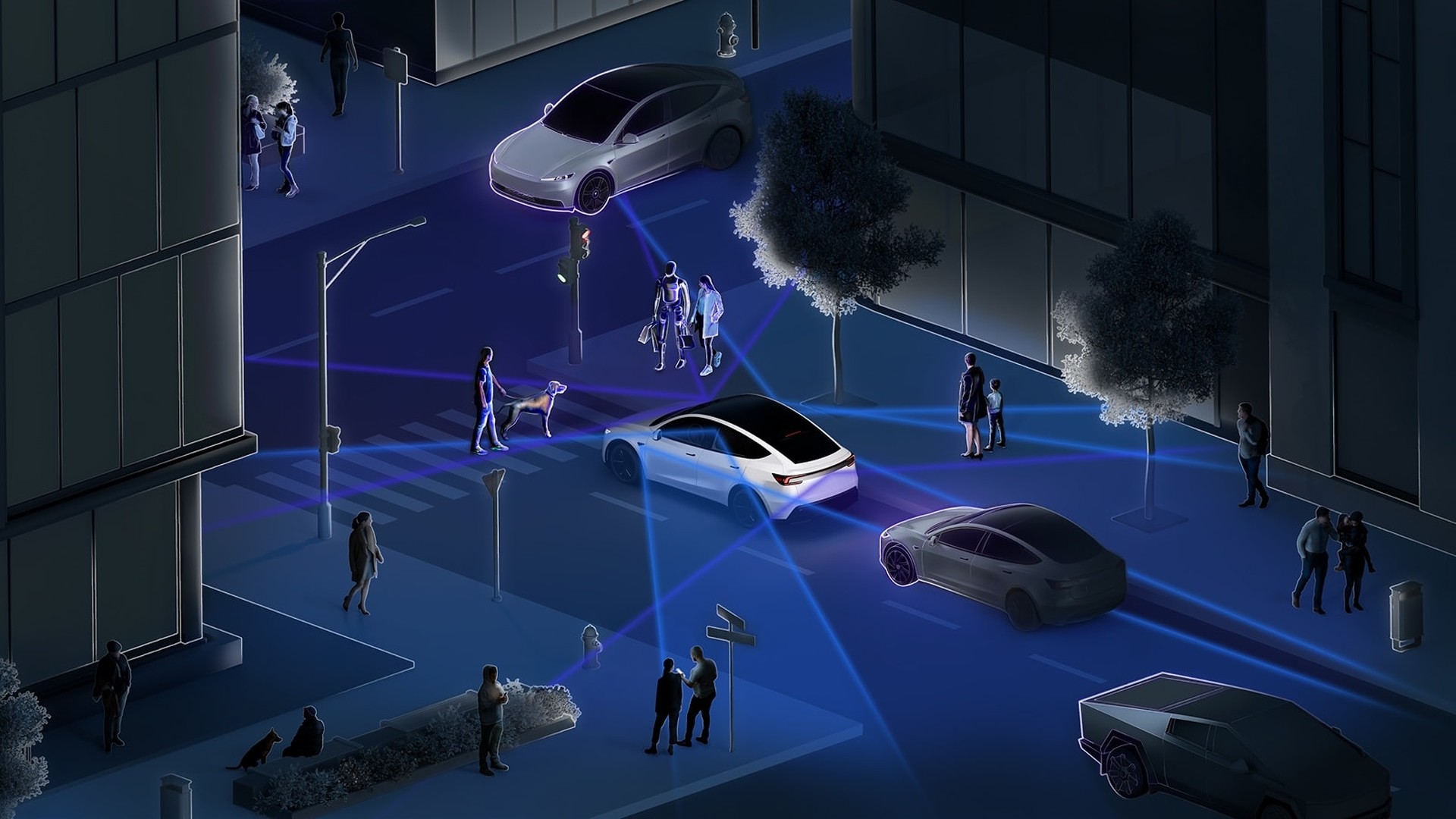
General Motors chief product officer Sterling Anderson, who once ran Tesla’s Autopilot program, says a camera-only self-driving stack will hit hard physical limits, even as Tesla’s own FSD (Supervised) safety report puts the vision system at more than 6 million miles per major collision in North America.
Anderson made the case in an October 27 interview with The Verge, arguing that dropping radar is a strange, almost faith-based choice that brushes past physics. He said radar costs so little that removing it makes little sense, that cameras struggle in dense fog, and that radar can measure instantaneous velocity in ways cameras cannot. Lidar, in his telling, also helps train camera models faster because it works on a wavelength close to visible light.
That multisensor bet is already on GM’s product calendar. The company says a 2028 Cadillac Escalade IQ will launch highway eyes-off driving with cameras, radar, and lidar fused together, rather than following Tesla’s vision-only path.
Tesla and Elon Musk have long argued the opposite: roads and signs are built for human eyes, so cameras plus neural nets are the scalable way to drive. Musk has also said lidar and radar can cut safety when sensors disagree with cameras, because the car then has to pick a winner, and that Tesla turned radar off in its cars for that reason. He has not publicly answered Anderson’s latest comments.
On the road, Tesla is already running unsupervised Robotaxi miles with a camera-only fleet in Austin and across Texas, where the registered Robotaxi pool recently passed 1,000 vehicles, and in Houston. Those rides do not carry the radar and lidar suite Anderson wants on GM’s personal autonomy products.
Anderson joined Tesla in 2014 from McKinsey, led the Model X program, then became director of Autopilot programs in November 2015 and left in December 2016 to co-found Aurora.
Tesla sued Anderson and Aurora in January 2017, alleging he recruited Tesla engineers and took confidential company information. The parties settled in April 2017, with Aurora paying $100,000 and agreeing to an audit of its systems, and with no admission of wrongdoing. He now leads product at GM.
Nearly every pillar of Tesla’s current autonomy stack arrived after that exit. The company shipped its in-house FSD computer on Hardware 3 in 2019, moved North American cars to camera-only Tesla Vision in 2021, opened FSD Beta in late 2020 and widened it through 2021, then replaced hundreds of thousands of lines of handwritten city-driving code with an end-to-end neural net in FSD v12 in 2024, followed by v13 and v14. FSD (Supervised) now clears more than 6 million miles per major collision, and unsupervised Robotaxi has run in Austin since June 2025 and later expanded to Houston.
If camera-only Robotaxis keep expanding while GM waits on a 2028 Escalade IQ stack, which approach will look safer to everyday drivers first?