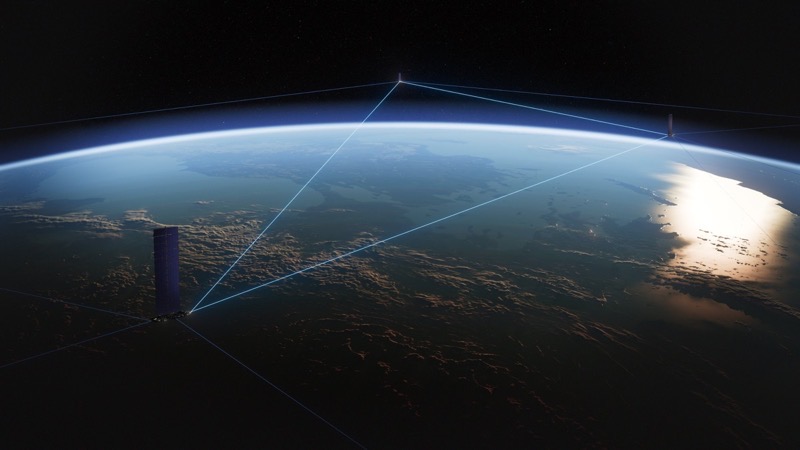
On Monday, September 25, at 1:48 a.m. PT, SpaceX’s Falcon 9 rocket launched 21 Starlink satellites from Space Launch Complex 4 East (SLC-4E) at Vandenberg Space Force Base in California. The launch added to Starlink’s existing satellite internet constellation
On Tuesday, SpaceX announced its Starlink constellation now comprises of more than 8,000 space lasers. The next-generation of these space lasers were first launched into orbit on Monday. These lasers enable the satellites to connect over thousands of kilometers, beyond the reach of ground stations.

The technology maintains pointing accuracy, facilitating data transfer rates of up to 100 Gbps on each link. Th advanced laser mesh network will allow Starlink to offer truly global coverage, including services to remote maritime and aviation customers, says SpaceX.
SpaceX first launched its laser satellites back in early 2021, but all Starlink satellite launches in 2022 included laser capabilities. There are now over 2 million Starlink customers worldwide.
Other articles in the category: SpaceX
SpaceX Targets Early April for Debut of Most Powerful Starship Ever
SpaceX CEO Elon Musk has confirmed that the debut flight of the company’s V3 (version 3) Starship is roughly four weeks away. The update, shared on March 7, 2026, places the highly anticipated launch of Flight 12 in early April at the Starbase facility in Texas. This upcoming mission represents a major generational shift for […]
Why Starlink Users are Furious Over the Sudden New “In-Motion” Speed Caps
Starlink users are waking up to a frustrating surprise as the company abruptly disabled “in-motion” data for its popular $5 US monthly standby plan. The change, which rolled out without prior warning, effectively cuts off internet access for Starlink Mini users as soon as their vehicle exceeds 10 mph (16 km/h). For many American and […]
Japan’s au Launches World’s First Starlink Satellite Roaming in the U.S.
KDDI and Okinawa Cellular have officially launched international roaming for au Starlink Direct in the United States. This marks the first time in the world that direct satellite-to-smartphone communication has functioned across international borders. Au is the second-largest wireless carrier in Japan, operated by KDDI. The service allows travellers from Japan to maintain a connection […]
If it wasn’t believable…it would be unbelievable!