Starlink’s 26 New V3 Satellites Are Healthy and Raising Their Orbits
SpaceX’s 26 new Starlink V3 satellites are healthy and raising their orbits. Here’s how the upgrade boosts capacity and why Starship matters.

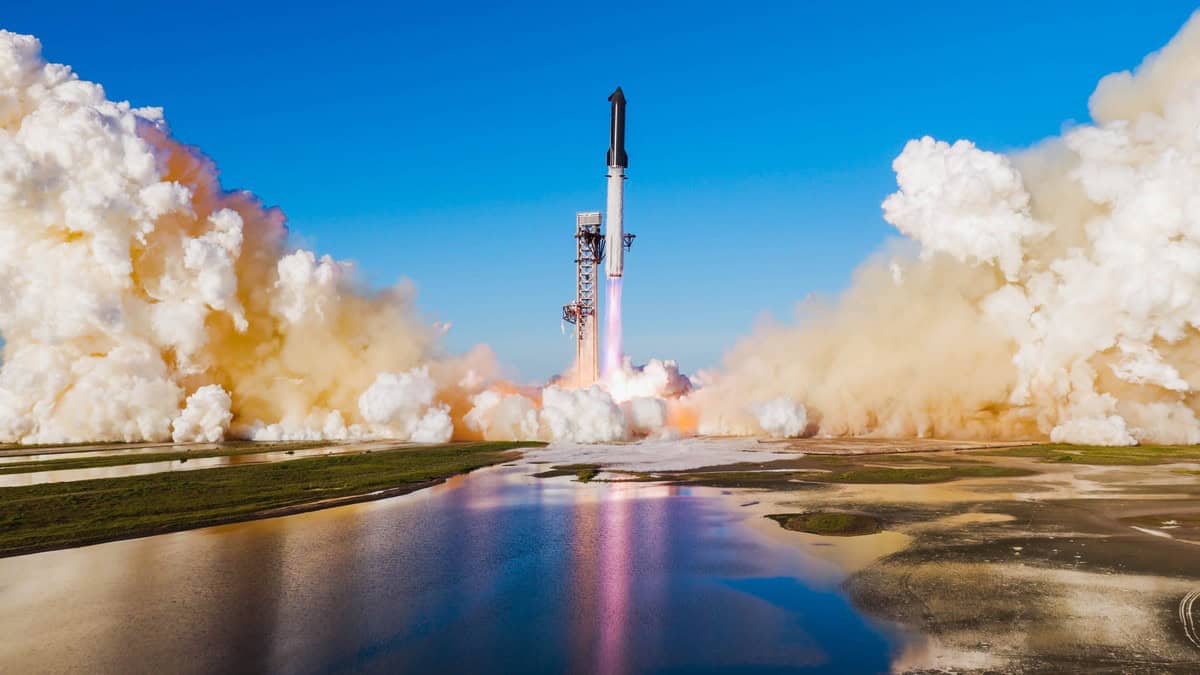
SpaceX’s latest batch of Starlink V3 satellites is off to a good start. All 26 spacecraft deployed during Starship Flight 15 on November 13 are healthy and have stayed in continuous contact since minutes after deployment, according to Michael Nicolls, who leads Starlink engineering.
In a November 14 update, Nicolls said the satellites were beginning to raise themselves toward their operational altitudes that morning. Getting them out of the rocket was the first big step. Now comes moving them into position to carry internet traffic.
How many Starlink V3 satellites are in orbit?
SpaceX has now delivered 52 production Starlink V3 satellites to orbit across two Starship missions: 26 on Flight 14 in late September, followed by another 26 on Flight 15. Starlink’s own space-safety update identifies the September batch as the first V3 deployment.
That is the deployed total; the latest health update specifically covers the 26 new arrivals. They are still on their way to their working orbits. SpaceX’s Flight 15 mission overview says satellites could begin serving customers as soon as a few weeks after launch, following orbit raising and on-orbit checks.
It is a sizeable step from the V2 satellites SpaceX has been launching aboard Falcon 9 since 2023. Flight 14 opened the orbital-delivery chapter for Starship, a milestone SpaceX recently revisited in its “Go For Orbit” documentary. Flight 15 has now repeated the delivery with another full batch.
What makes V3 better?
According to Starlink’s V3 specifications, each satellite is designed for 1 terabit per second of downlink capacity and 160 gigabits per second of uplink capacity. That is roughly 10 times the downlink and 22 times the uplink capacity of V2. Those are shared satellite capacities, rather than the speed of a single home connection.
The upgrade also packs far more flexibility into each satellite. V3 supports 2,048 beams in each direction, compared with 192 downlink and 144 uplink beams on V2. More beams and upgraded chips let the network serve more customers at once and shift capacity toward areas that need it.
Six 400-gigabit laser links help move traffic between satellites, while new solar arrays generate about twice as much power as V2’s. The result is more than a faster radio: it is a bigger, more capable piece of the network overhead.
Why Starship is the gamechanger
For this particular flight, SpaceX says the 26 V3 satellites represent about as much added capacity as 10 Falcon 9 launches carrying V2 Mini satellites. In other words, one Starship mission can do a lot of network-building heavy lifting.
Starlink’s broader V3 roadmap puts the potential at roughly 20 times the capacity per Starship launch compared with a Falcon 9 launch of V2 satellites. The Flight 15 comparison is about 10 times; the larger figure describes the company’s wider deployment ambition.
That is why Starship matters so much to Starlink’s next phase. Bigger satellites deliver more bandwidth, and a bigger rocket can put that capability into orbit in much larger chunks. If SpaceX can pair that payload advantage with regular flights and rapid reuse, expanding the network becomes a very different proposition. For customers, the payoff is straightforward: more capacity to share, especially where demand is already stretching the network.
Tesla news, every morning.
Software updates, deliveries, FSD rollouts. Five minutes. Free.