Credit: Tesla
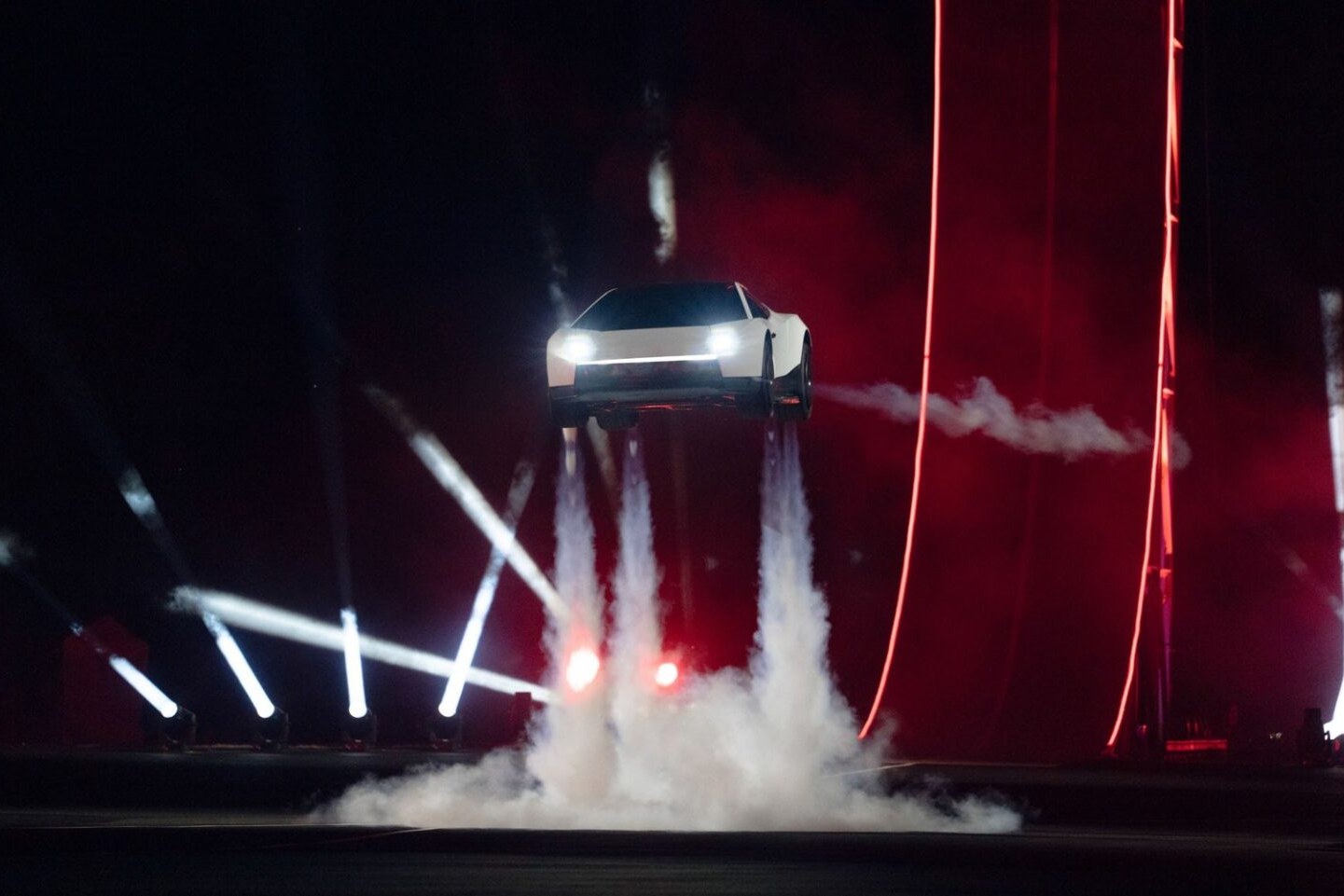
Tesla’s vehicle engineering chief says the flying version of the new Roadster is not a stage trick, and that the numbers behind its liftoff are straightforward. Lars Moravy says the car’s cold gas thrusters put out more than three times the force needed to get it off the ground, even when he assumes a deliberately heavy weight for the car.
That’s according to Tesla’s Lars Moravy, the company’s vice president of vehicle engineering, who posted on X on Wednesday afternoon in reply to British motoring journalist Tom Ford. Ford had written on October 16 that he had sat in the new Roadster and believed the base car, but not the flying one. “I’ve sat in this. Talked to everyone. The ‘basic’ car is eminently real – and very cool. But the flying one? The physics are off – it couldn’t brake/rotate in the air like that at ‘car’ weight,” Ford wrote.
Moravy opened his reply bluntly, writing that “we don’t show things that we can’t do in production.” He then laid out the numbers: “The cold gas system can produce over 80kN of force. If everything weighs even a ridiculously high 2500 kg with the mass of gas plus the thruster system, the lift from the thrusters is >3x the mass of the vehicle.” With that much extra lift over time, he added, the car has “spare air to flip” and maneuver, calling it “simple math really.”
Running his figures ourselves, a 2,500 kg car (about 5,500 pounds) needs roughly 24.5 kN of upward force just to hover, so 80 kN works out to about 3.3 times that. In more familiar units, 80 kN is close to 18,000 pounds of thrust. Moravy’s 2,500 kg number is also well above the ballpark he gave last week, when he said the Roadster should come in at “just under 1,700 kilos,” though he noted final weight figures were still coming.
Ford isn’t fully convinced yet. On Thursday morning, he replied to Moravy asking, “Can you confirm that was a full on production car Lars? With everything in it?” In a separate reply in the same thread, he argued the flying car is a different kind of machine, writing, “It’s not a car with a battery.” Moravy had not publicly answered the follow-up question at the time of writing.
Tesla unveiled the Next Gen Roadster on October 15 outside Waco, Texas, in three configurations called Performance, Thrust and Rocket. As we covered in our Tesla Roadster reveal story, the single-seat Rocket uses perimeter-mounted cold gas thrusters that Tesla says provide forward, upward, sideways and rotational movement, with the company stating, “So…yes, it can fly.”
Moravy went deeper on the hardware in an interview recorded the day before the reveal, which we broke down in our story on how the Roadster’s fans, wings and thrusters work. He described a 200-liter carbon-wrapped tank holding nitrogen at up to 10,000 PSI, feeding thrusters that produce over 80 kN. The Rocket adds another 400 liters of storage for 600 liters in total, plus six more thrusters, including one in each corner and two at the front to yaw the car, which speaks directly to Ford’s point about rotating in the air. Filling all 600 liters takes 6 to 7 hours today, with a goal of about half an hour.
Where and when the Roadster will be built is still an open question, despite Moravy’s “production” comment. Tesla’s Q3 2026 Update lists the car with a region of “TBD” and a status of “Design development,” as we noted in our six takeaways from Tesla’s Q3 deck. In last week’s interview, Moravy said Tesla had four or five Roadster prototypes, with a bigger build planned early next year.
Does Moravy’s math settle the debate for you, or do you want to see a production Roadster Rocket fly before you believe it?