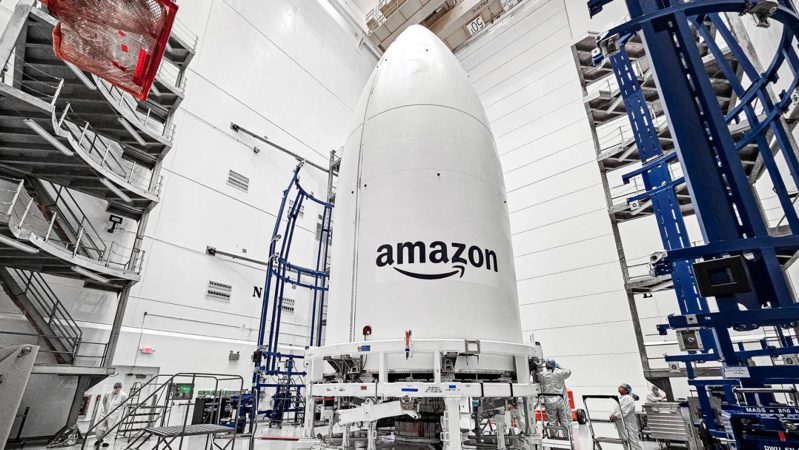
Amazon is set to launch its first two prototype satellites, KuiperSat-1 and KuiperSat-2, as part of its Project Kuiper initiative aimed at providing fast, affordable broadband from low Earth orbit (LEO). The launch marks Amazon’s entry into the burgeoning space broadband market, where it will try to compete with SpaceX’s Starlink network.
The Protoflight mission will serve as a crucial testing phase for Project Kuiper, which plans to deploy more than 3,200 satellites over the next six years. Rajeev Badyal, Project Kuiper’s vice president of technology, emphasized the importance of on-orbit testing. “This is Amazon’s first time putting satellites into space, and we’re going to learn an incredible amount regardless of how the mission unfolds,” said Badyal on Thursday.
Key Elements of the Protoflight Mission:
- The satellites will be launched atop an Atlas V rocket from United Launch Alliance (ULA).
- The mission will test advanced LEO broadband satellites, customer terminals, and a ground-based communications network.
- Telemetry, tracking, and communications stations will establish first contact with the satellites.
- Onboard systems and subsystems will be tested for power and temperature ranges.
- Ground-based advanced networking hardware and software will be tested for data flow through the Kuiper System and AWS.
The mission aims to gather real-world data to complement years of lab and field testing, offering insights into the network’s performance in both ground and space operations. The data will also inform mission procedures for satellite processing, launch, and operations.
Amazon has engineered the Kuiper System for continuous improvement and plans to apply learnings from the Protoflight mission to refine its hardware, software, and infrastructure. The first production satellites are scheduled for launch in the first half of 2024, with beta testing for early commercial customers expected by the end of that year.
According to astronomer Jonathan McDowell, who tracks Starlink satellites, there have been 5200 Starlinks launched to date, while there are currently 4,845 in orbit, as of the end of September 2023. Amazon has a ways to go before it can even rival SpaceX’s satellite constellation. SpaceX says Starlink recently passed 2 million customers worldwide.

This is strictly an ego thing for Jeff Who as there is no way they will be able to launch them at SpaceX’s costs and then scale up profitably. It will take them years and years and then SpaceX just needs to drop prices a little and Amazon loses more money. Good luck as they’ll need it and a lot more.
Of the 3 launch companies contracted with Amazon, Blue Origin and Arianespace (Ariane 6) have not placed any satellites into orbit yet, and ULA has a launch cadence that’s far too slow (3 launches YTD, including the Kuiper protoflight), compared with 70 SpaceX launches so far this year. Also, without a reusable booster, the cost to launch 3,200 satellites will be a huge financial disadvantage for Amazon.
The lawsuit against Amazon for not soliciting SpaceX as a launcher may very well have merits, since there seems to be no sound business reason to not take a SpaceX bid.
I noticed that Coca Cola just entered into an agreement with Volvo to test out their EV trucks. I guess you have to try things sometimes before learning your lesson ha. In fairness, I suppose Volvo will make a good short haul truck but if they want to carry mass over long distances I think the Tesla Semi is still the only option to date. Point? Blue Origin can operate their Carnival Ride rockets to the edge of space for those who want to feel weightless for a couple of minutes but if you’re planning to bring any worthwhile cargo (not that humans aren’t worthwhile) into orbit and still have some cash left in your wallet, SpaceX seems to be the only choice to date. I don’t know how anyone can overcome the massive initial investments needed to get to SpaceX’s economies, and by the time they do, if they do, where and what will SpaceX be at and offering by then?
Getting a mass of 1 kg to an altitude of 100 km in a BO rocket requires a potential energy of gh = 9.8 x 10^5 J. Keeping a mass in orbit requires an additional horizontal velocity v which will counter the downward gravitational acceleration g. The “centrifugal” acceleration = v^2/R = g, or v^2 = gR, or KE = 0.5 gR per kg. R is the distance from the center of the earth, which at 100 km altitude is 6500 km. So the additional KE required to orbit said object is 0.5 x 9.8 x 6.5 x 10^6 J/kg = 3.19 x 10^7 J/kg, to which we can add the previous PE to get a total energy = 3.29 x 10^7 J/kg.
Bottom line, the 100 km joy ride requires a measly 3% of the energy to put any of the tourists into orbit. Mathematically, the disparity is due to the difference between h, the altitude above earth’s surface, and R, which is magnitudes larger (gh vs gR/2). The Starlink constellation is at an orbit of 550 km, far higher than BO has yet reached, let alone orbited. So yeah, I don’t see how Amazon can do it economically, or quickly enough.
My math (lack of it) was easier ha!