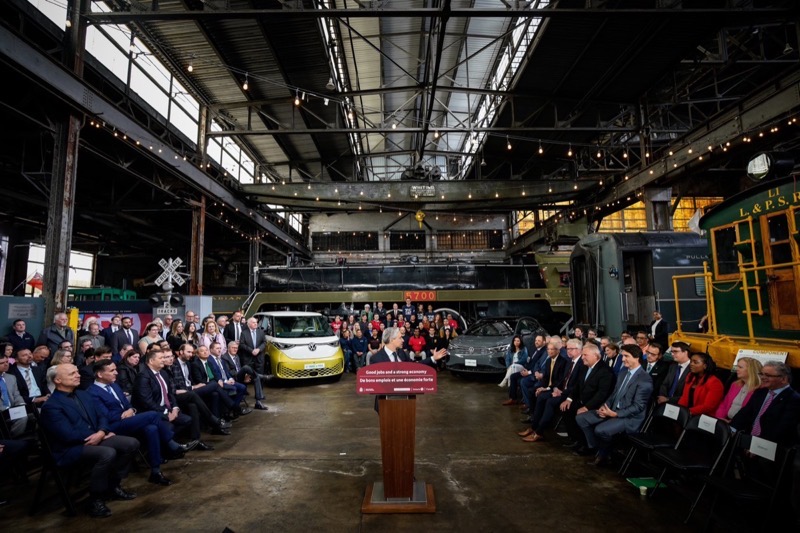
Volkswagen is taking a significant step forward in its electric vehicle strategy in North America, announcing the construction of its largest gigafactory to date in St. Thomas, Ontario, Canada.
With a planned investment of up to €4.8 billion / CAD$7 billion by 2030, the facility will have an annual production capacity of up to 90 GWh in the final expansion phase and create up to 3,000 highly skilled jobs at the factory, as well as tens of thousands of indirect jobs in the region.
Canada’s Prime Minister, Justin Trudeau, hailed the announcement as a win for workers, the community, and the economy. Volkswagen Group Board Member for Technology, Thomas Schmall, emphasized the importance of North America in the company’s global battery strategy and expressed the aim to make PowerCo SE, Volkswagen’s battery company, a global player in the battery business.
The St. Thomas gigafactory, set to break ground in 2024 with production beginning in 2027, will equip Volkswagen Group brands’ BEVs in North America with cutting-edge unified cells, a new cell technology designed for volume production. The facility is part of a larger plan agreed upon between Volkswagen, PowerCo, and the Canadian government to promote e-mobility in the country.
CEO of PowerCo SE, Frank Blome, expressed his gratitude for partnering with Canada, Ontario, and the City of St. Thomas in taking the EV industry to new heights. Canada’s Minister of Innovation, Science and Industry, François-Philippe Champagne, highlighted the investment as a testament to Canada’s competitiveness in attracting major investments and the nation’s status as the green supplier of choice to the world.
Located in the heart of the Great Lakes Automotive Corridor, the cell factory will span 370 acres (150 hectares) and be supplied with 100% CO2-free energy. Ontario’s Premier, Doug Ford, celebrated the investment as the largest auto investment in the province’s history and thanked Volkswagen and PowerCo SE for their confidence in Ontario’s workers and growing EV supply chain.


I am a solar/wind/battery renewable energy freak that drank the EV KoolAid years ago but this seems really over the top on so many different levels. The time for EV incentives has passed because the demand is far ahead of production capacities and will be for a couple more years at least. I’ll take them if offered but to me the better way to go is to increase taxes, penalties for emissions from ICE cars and Fossil Fuel energy generating plants. China and Europe are leading with carrot and stick approaches and this has led to the technology now being good enough for mass adoption. Yes, EVs are still pricey but both of Tesla’s best selling vehicles the Model 3 and the Model Y are presently selling quite a bit below the average new car sales prices in the US! The cost savings over lifetime ownership makes buying one a no brainer even if it requires a “stretch” financially at first. ICE resale values are going to plummet (already happening) while EV’s resale values will be much higher, reducing risk and/or giving better trade in values later. As for VW making 1M vehicles from this “possibly the biggest battery plant in the world” that would only need about 65GWh of batteries. CATL in China is bringing a 70GWh plant online this year and Tesla has 2-3 100GWh+ plants already in the works too which could be ramped up to 250GWh each by the time this VW project comes on line. At $13B this is a big deal but it is really an unnecessary bribe that will probably mostly go in unintended places.