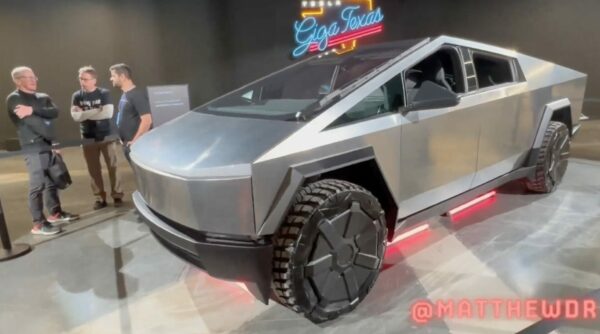
Photo: Matthew Donegan-Ryan
Tesla and CEO Elon Musk’s plans to cut costs by 50 percent on its next-generation platform bring to light new questions for legacy automakers looking to catch up in the emerging electric vehicle (EV) sector.
Namely, experts expect Tesla to gain access to thousands in cost advantages over its rivals, all while competitors attempt to keep up with the company’s tear in the new industry, reports the Wall Street Journal.
“There is a clear path to making a…smaller vehicle that is roughly half the production cost and difficulty of our Model 3,” Musk said at a Morgan Stanley conference earlier this month.
The comments mirrored statements made at Tesla’s Investor Day event, in which executives pointed to the automaker’s next platform as a major attempt to drive down production costs.
UBS analyst Patrick Hummel noted the cost-cutting measures in recent discussion with Volkswagen officials regarding the ID.3. Currently, the ID.3 is roughly $40,000 in Europe and is only “slightly above break-even levels,” according to Hummel.
“I really struggle to see how VW is going to have an affordable EV that’s profitable to you in a couple of years’ time,” Hummel said.
“We are very aware that competition will become tougher,” Arno Antlitz, VW’s chief financial officer, said. “So we try to stay as fixed as possible on the overhead cost side.”
General Motors CEO Mary Barra was asked about matching Tesla’s margins and cost structures, by Rod Lache, an analyst for Wolfe Research in Feburary. She replied, “Our aim is to have industry-leading margins as we invest.”
Morgan Stanley analyst Adam Jonas, was convinced after Tesla’s Investor Day the automaker will have a significant advantage as it reduces costs. “In a race to the bottom, we seriously question how the competition can keep up,” wrote Jonas in a research note.


The big difference between Tesla and all the other offerings, including most ICEs is that they have enough margin/profits to be able to “bend” with the economic forces driving these price cuts. GM makes about $2k per vehicle and as that would be strictly ICE driven, cutting EV prices just means more loss on top of their already unprofitable EV sales. Cutting ICE prices by about $2k means losing their profits entirely. It is no wonder they are slow to scale/ramp up! The more they make, the more they lose while with Tesla on the other hand, price cuts mean more sales and more market share, butts in seats and further conquests as they play Yogi Bear and steal everyone else’s picnic baskets. VW makes about $1k per vehicle sold and Ford is actually losing money per vehicle sold without even counting in EV losses. Toyota makes about 1/8 the profit per car that Tesla makes so as long as they don’t make loss generating EVs (every EV made will be a loss leader for at least the next 3-4 years) AND manage to keep their ICE sales constant (they won’t), they should be “fine” ha! The entire auto industry is facing pressure from inflation and high interest rates, market uncertainty etc. so we’re entering a phase where the weak will get weaker (perish?) while the strong get stronger. As the entire industry is in serious shift to EVs that means that any company who can’t make profits on EVs (all legacy automakers to date) is losing, getting weaker, while those who are making EVs at profit (Tesla) are indeed getting stronger. The next couple of years are going to be critical to the survival of the Big Old Boys and personally I think they have too much stacked against them to reach profitability at all. RIP ICE
I agree with @Bill Johnson. A few Chinese auto companies and Tesla are the only companies making money on EVs. The legacy auto makers need to hold onto their ICE sales for as long as possible to fund the transition to EVs. Unfortunately, that path is self-defeating since the further along in the transition the lower their revenues from traditional ICE sales. It’s a balancing act that no company has demonstrated any competence in. It requires eliminating all investment in ICE vehicles starting now and moving those investments into EVs, batteries and charging infrastructure. At least GM and Ford seem aware of their predicament. The Japanese car companies are whistling past the graveyard.