Photo: Tesla
Tesla’s previously scrapped Dojo supercomputer project is officially back on the table — and this time, it’s returning with far more clarity about its role in the company’s AI roadmap.
Elon Musk confirmed this week that Tesla will restart work on Dojo 3 now that its next-generation AI5 chip is “in good shape.” In a post on X, Musk said, “Now that the AI5 chip design is in good shape, Tesla will restart work on Dojo3,” while actively recruiting engineers to help build what he described as “the highest volume chips in the world.”
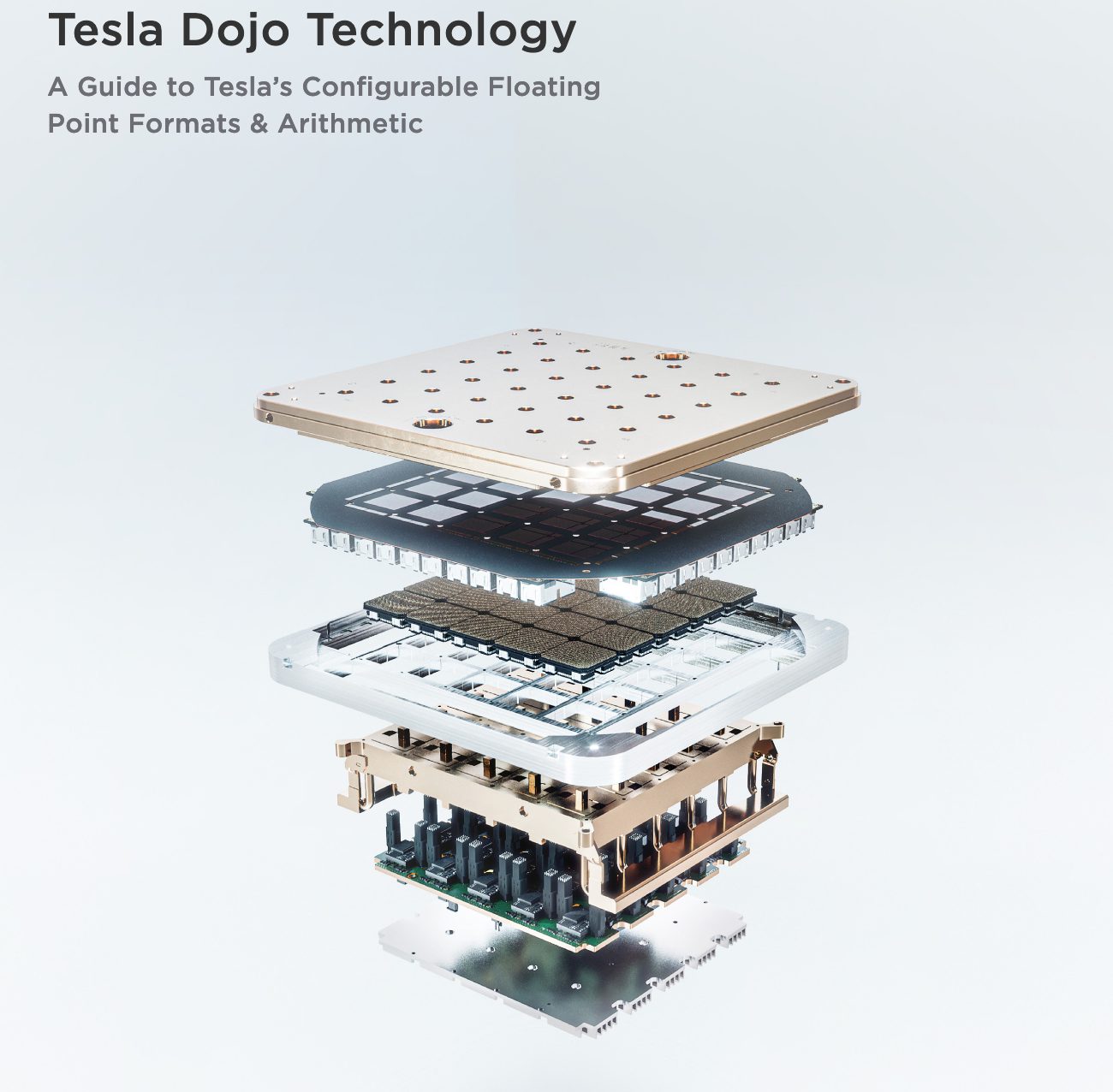
Dojo was originally unveiled in 2019 as Tesla’s in-house AI training supercomputer, designed around its custom D1 chip to train neural networks for Full Self-Driving and beyond. But last summer, Musk made the controversial decision to effectively shelve Dojo, calling Dojo 2 an “evolutionary dead end” while redirecting nearly all engineering resources toward fixing AI5 — also known as Hardware 5 (HW5).
That move now looks more strategic than reactive. According to Musk, “Solving AI5 was existential to Tesla,” adding that he personally spent “every Saturday for several months” working on the chip. The result, he says, is a highly capable design that rivals Nvidia’s Hopper architecture as a single SoC and offers Blackwell-class performance in dual configurations — but at a fraction of the cost and power consumption.
With AI5 nearly complete, Tesla has breathing room again. Rather than maintaining separate chips for real-time inference in cars and robots versus large-scale AI training, Tesla is converging on a single chip family. Those same chips that power millions of vehicles and Optimus robots will now scale into massive training clusters inside data centers — and eventually beyond Earth.
That’s where Dojo 3 comes in. Musk has already hinted that AI5 will deliver the epitome of autonomous driving performance and AI6 will focus heavily on Optimus and data centers, while both AI7 and Dojo 3 are expected to be designed for space-based AI compute. In other words, Dojo isn’t just coming back — it’s being reimagined as part of a unified, vertically integrated compute stack spanning cars, robots, data centers, and orbit.
Unlike legacy automakers and AI labs that rely on Nvidia hardware as a permanent cost, Tesla is building its entire AI pipeline in-house. With AI5 now unblocking the roadmap, the Dojo flywheel is spinning again — and it may ultimately require something Musk has repeatedly teased: a full-blown Tesla “Terafab” to keep up with chip demand.


