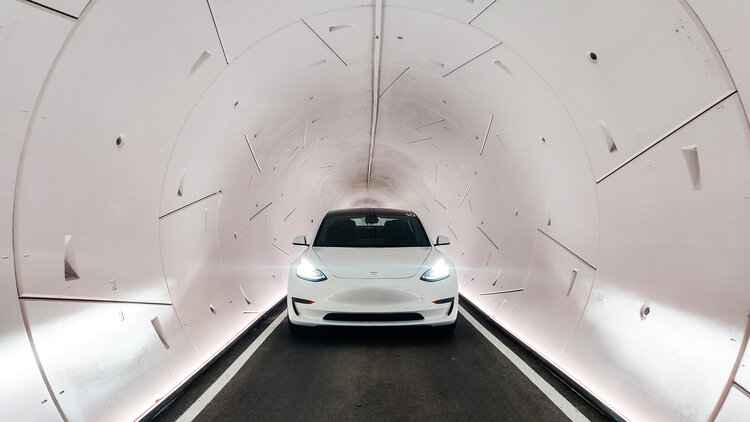
The Boring Company’s Nashville tunnel project, officially dubbed the “Music City Loop,” could cost anywhere from $240 million to $300 million to construct, according to new estimates reported by the Tennessee Lookout.
Jim Fitzgerald, Chief of Development for The Boring Company, revealed the numbers earlier this week during a meeting of the Nashville Rotary Club. The 10-mile tunnel will connect downtown to the Nashville International Airport (BNA) with two underground lanes designed to shuttle passengers using Tesla vehicles.
The proposed costs come in significantly lower than traditional industry rates, which can run from $500 million to over $1 billion per mile for a similar two-lane system. Fitzgerald said The Boring Company’s in-house engineering model allows it to cut costs while still delivering large-scale infrastructure.
Despite the $300 million valuation, the entire Nashville loop will be privately funded with zero taxpayer dollars involved. The Boring Company first announced plans for the project back in July, with the Tennessee Building Commission approving a no-cost lease for the state-owned launch site. Tennessee is also expected to grant long-term underground right-of-way access beneath state highways to support construction.
However, that hasn’t stopped critics from raising questions about safety, environmental impacts, and Nashville’s unique underground karst terrain, which features sinkholes, caves, and streams. The project has also faced scrutiny from Metro Nashville Mayor Freddie O’Connell’s office, which has flagged permitting and safety concerns.
Fitzgerald noted that the tunnels will be waterproof, equipped with sump pumps, and paired with elevated stations to mitigate flood risks. He added that the company’s deeper digging approach should avoid unpredictable rock layers closer to the surface.
The Boring Company, founded by Elon Musk, recently opened a new Global Operations Control Center in Bastrop, Texas, from where it can remotely monitor and control tunneling projects across the U.S., including the Nashville loop. The company is also expanding its Vegas Loop system, although that project has been bogged down by regulatory snags and recent safety incidents.
If the Music City Loop proves successful, Fitzgerald said it could pave the way for additional tunnel lines throughout the region.

