Tesla announced on Friday it has achieved a major milestone for the production of its 4680 battery cells.
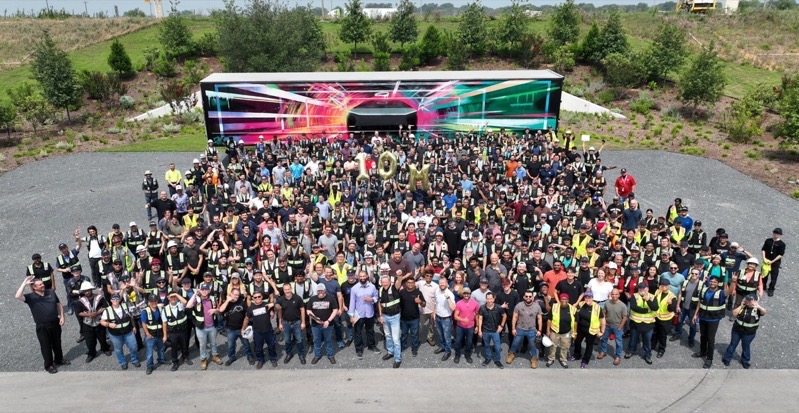
The company said, “produced our 10 millionth 4680 cell at Giga Texas this week,” while sharing a picture of its employees, with balloons “10M” signifying the achievement.
Last January, Tesla reached 1 million 4680 cells produced, so this latest milestone comes just 17 months later to ramp up by 10x. At 10 million 4680 cells, that’s enough to make 11,520 vehicles, according to the company’s calculations.
Back in December, Tesla said it had reached 868,000 cells in one week for the first time ever, enough to make battery packs for 1,000 cars.
In a now deleted tweet, Tesla said on Thursday it had reached 500,000 Powerwall installations. Powerwall is the company’s residential solution for energy storage, allowing owners to store power from solar panels or the grid, all managed by Tesla software .
Other articles in the category: News
Tesla Introduces New ‘Immersive Sound X’ for Model Y
Tesla has officially launched a new audio feature called Immersive Sound X to enhance the entertainment experience in the Model Y. The technology focuses on creating a cinematic 3D soundstage by using advanced algorithms to separate different parts of an audio track. The system analyzes music in real-time to pull direct sounds like vocals or […]
The End of an Era: Tesla Builds Final V3 Supercharger at Giga New York
Tesla is entering a new era of electric vehicle infrastructure as the company officially transitions production to its next-generation charging hardware. On March 16, Tesla Charging confirmed that its Buffalo, New York, facility has completed production of its final V3 Supercharger cabinet. The move marks the conclusion of a massive hardware cycle that saw more […]
Ontario’s SpaceX Feud Ends in Secret Payout and Rural Internet Delays
The now-cancelled agreement between Ontario, Canada, and SpaceX was first signed in November 2024. It was designed to provide satellite internet to roughly 15,000 homes in the northern and rural parts of the province through the Ontario Satellite Internet (ONSAT) program. At the time, the $100 million deal was seen by some government sources as […]