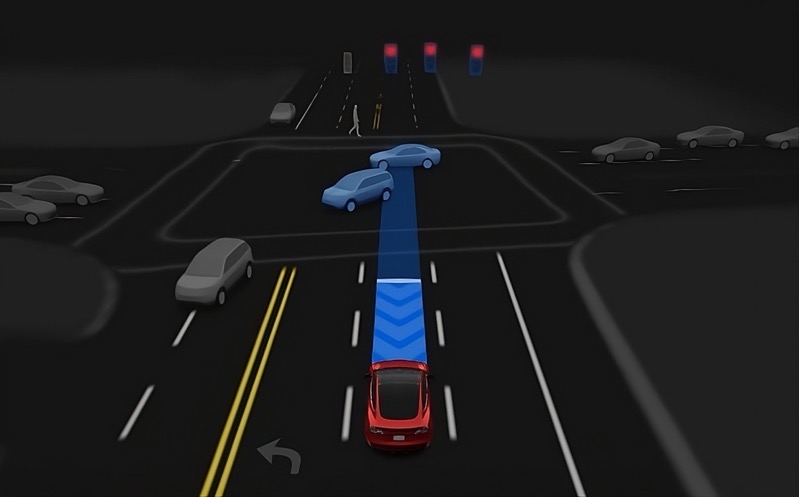
Tesla has published its latest quarterly safety data, revealing that its Autopilot technology continues to outperform human drivers by a significant margin when it comes to reducing accident risk.
According to Tesla’s Q3 2025 Safety Report, the company recorded one crash for every 6.36 million miles driven in which drivers were using Autopilot. In comparison, for drivers not using Autopilot technology, Tesla recorded one crash for every 993,000 miles driven during the same period. That means Tesla’s Autopilot reduces the likelihood of a crash by more than six times compared to drivers not using Autopilot.
For context, the most recent data from the U.S. National Highway Traffic Safety Administration (NHTSA) and the Federal Highway Administration (FHWA) — from 2023 — shows that there was an automobile crash approximately every 702,000 miles across the United States.

Tesla also revealed that owners drove more than 1.3 billion miles on Full Self-Driving (Supervised) in Q3 2025, marking a new quarterly record. That averages out to around 14.1 million miles per day, up from 11 million miles per day in Q2 — underscoring how rapidly FSD adoption is growing among Tesla’s user base.
A report from earlier this year suggested that Tesla’s Full Self-Driving (Supervised) software reduces accident risk by an even greater margin — 26 times safer than U.S. drivers based on real-world data. Meanwhile, CEO Elon Musk has said that FSD version 14, which began rolling out more broadly earlier this week, could make Tesla vehicles two to three times safer than human drivers once it’s fully refined.
As Tesla continues to improve its AI-driven driving systems, the data points to a growing gap between human and machine-assisted driving performance — something the company hopes will pave the way toward full autonomy in the coming years.
Other articles in the category: Tesla

Tesla Officially Kills $8,000 FSD One-Time Purchase in U.S.
After more than nine years of offering Full Self-Driving (FSD) as a one-time software purchase, Tesla has officially pulled the plug on the upfront option in North America. As expected, the previous $8,000 one-time FSD purchase — available either when ordering a vehicle or after delivery — is no longer available in the U.S. Going […]

Tesla Replaces Coal: $330M Battery Goes Live in Australia
A new grid-scale battery powered by Tesla Megapacks is now officially online in Queensland, Australia, marking another major milestone for the company’s fast-growing energy storage business. As first reported by Energy-Storage.News, publicly owned energy company CleanCo Queensland has opened the Swanbank Battery Energy Storage System (BESS), a 250 MW/500 MWh facility located at the former […]

Tesla Launches $450 Mezcal: 50 Lucky Buyers Get Signed Boxes
Tesla is back in the spirits game — this time with a design-forward twist. The company has quietly launched a new Tesla Mezcal | Design Studio Edition in the U.S., priced at $450. The limited-run bottle leans heavily into Tesla’s design ethos, complete with a specially crafted box sleeve that features early sketches of the […]


Bullshit do not trust self company reports.